(216) 373-7706
- Originally Published on January 19, 2026
How to Deal With Defamation on X (formerly Twitter)

X (formerly Twitter) is one of the most popular social media platforms in the world, with over 335 million monthly active users worldwide as of 2024. Yet, the growing popularity of the platform correlates with an increase in abusive behavior and unlawful content, such as defamation on X (formerly Twitter).
A post, repost, account, video, or other media on X may be considered defamation if:
- It asserts a false statement about the plaintiff,
- It was published or communicated to a third party,
- It was made with at least a negligent level of intent, and
- It caused damage to the plaintiff’s reputation.
At Minc Law, we have removed over 200,000 pieces of unwanted online content, including social media defamation. We know what it takes to stop internet harassment, remove negative content, and preserve your online reputation. And we know how to successfully represent clients without drawing additional unwanted attention to the matter at hand.
In this article, we will discuss defamation on X (formerly Twitter), as well as what you can do if you discover a defamatory post. Finally, we will explain how a legal team can help resolve your defamation matter on X. Because not all negative posts are defamatory, we will start by looking at some examples of posts that constitute defamation.
Examples of Defamatory Posts on X (Formerly Twitter)
Social media defamation is a growing problem as social media platforms become more popular. Since defamation can wreak havoc on one’s personal and professional reputation, it is useful to know how to spot defamatory posts on social media, such as X.
What Makes a Post on X Defamatory?
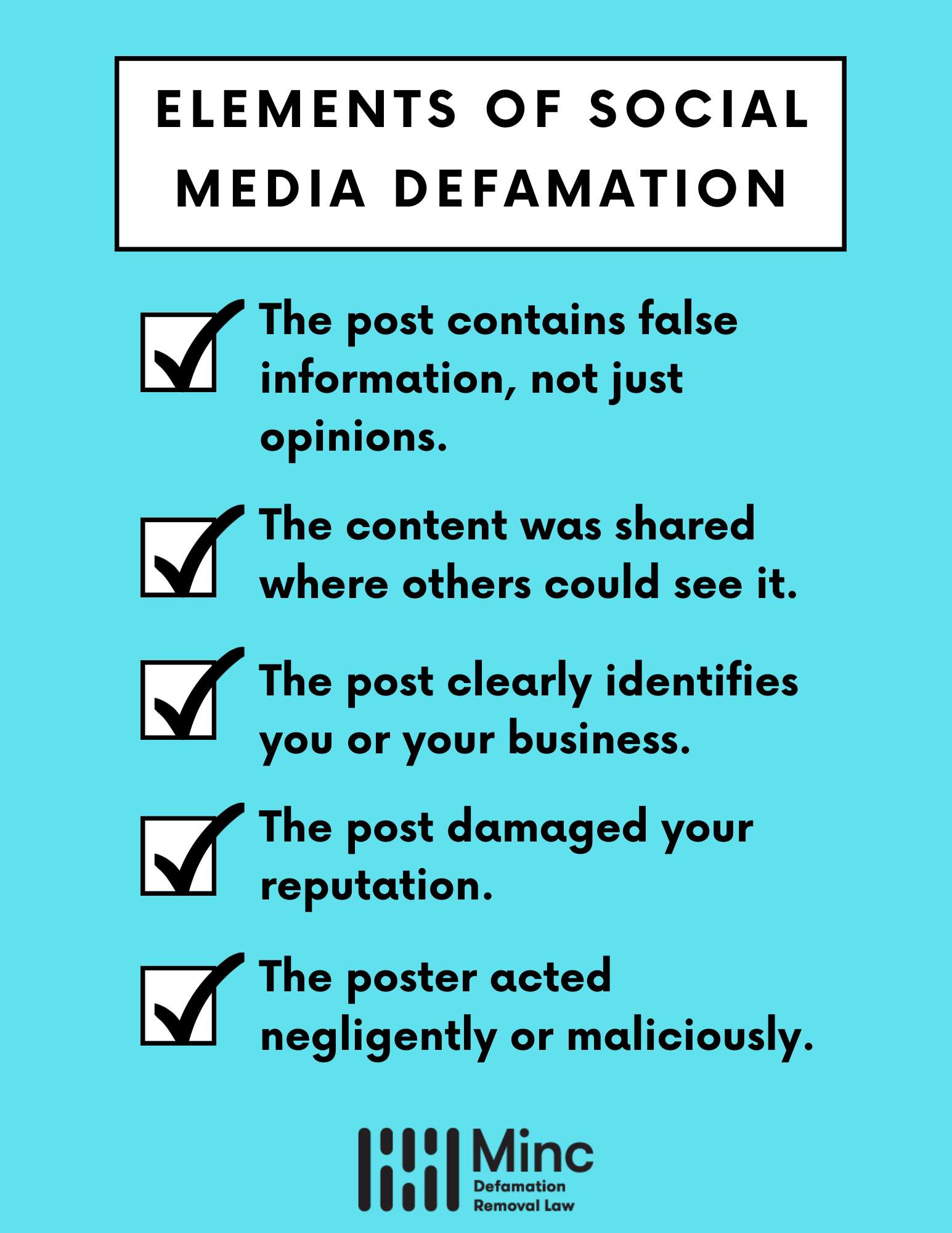
There are an infinite number of ways a post can strike a nerve, but an offensive post is not necessarily defamatory. For a post to be defamatory, it must include the following four elements:
- A false statement made about the plaintiff or victim of defamation,
- The statement was communicated to at least one other third party,
- The person making the statement was at least negligent when considering if the statement was actually true, and
- The false statement damaged the plaintiff’s reputation.
While defamation is an umbrella term that covers both slander and libel, most defamation on X is considered libel. The core difference between libel and slander is that libel is published in a tangible medium such as a newspaper or video, while slander is spoken aloud.
Common forms of defamation on X (formerly Twitter) include:
- False posts, comments, and reposts (formerly retweets),
- Fake profiles and accounts, and
- Photographs, videos, or other media containing false information and attacks.
Nevertheless, the remedies for libel and slander are the same. When proven successfully, victims of libel and slander can potentially get the false content removed from the internet and recover monetary damages.
Now, we will take a look at each of those elements necessary to prove defamation on X.
There is a False Statement Made About The Plaintiff
The defamer must speak or publish a false statement about the plaintiff. Truthful statements (even if they are negative) do not usually constitute defamation.
Furthermore, some states may classify a statement as defamatory in cases where the substance of the statement is true, but conveys a defamatory implication. This is commonly referred to as ‘defamation by implication’.
The Statement Was Communicated to a Third Party
The defamatory statement must be shared with at least one other person. If a defamer merely utters a false statement when no one else is around to hear, you will not be able to prove defamation.
The Statement Was Made With At Least a Negligent Level of Intent
You must show the defamer published the statement without attempting to determine whether it was actually true or false. Even if they did not intend to share a lie, they must have been negligent when considering the truthfulness of their statement.
The Statement Caused Damage to the Plaintiff’s Reputation
Lastly, the plaintiff must show they suffered damage to their reputation that led to financial harm.
What Are Some Recent Examples of Defamatory Posts That Made Headlines?
Justin Bieber & Fictitious Defamers
Singer Justin Bieber is a famous target of alleged defamation on social media, with a case that originated on Twitter in 2020. Two Twitter users made posts alleging they were assaulted by Bieber in 2014. Bieber denied their claims and promptly filed a defamation lawsuit against the account holders, only to discover that both users were using fictitious names.
Bieber successfully obtained a court order to uncover the identity of the anonymous defamers through the legal discovery process, demonstrating how John Doe lawsuits can be used to unmask anonymous accusers on social media platforms.
Monir v. Wood
Across the pond, a Twitter battle turned ugly, leaving an account holder liable for tens of thousands in damages in Monir v. Wood. Chairman of the Bristol Branch of UKIP, Steve Wood, managed the Twitter account @BristolUKIP as a volunteer.
The Vice-Chairman of UKIP published a tweet accusing Zahir Monir of “child grooming,” along with a picture of Mr. Monir posing with a member of an opposing political party. When Monir sued for defamation, UK courts held Wood liable for the tweet, even though he was not the individual who posted the tweet. He was responsible for and affiliated with the Twitter account, which the UK court found enough to sustain liability.
What is Protected By the First Amendment When it Comes to Posts on X?
Just because someone shares a negative opinion about you or your business online does not mean it is defamatory or unlawful. The First Amendment protects the rights of others to express themselves, even if you do not like what they have to say.
Courtney Love’s Tweet Lacking the Requisite Malice to Constitute Defamation
In one case that made national news, celebrity Courtney Love was sued for defaming her former attorney, Rhonda Holmes, on Twitter. Holmes represented Love for an estate dispute over Love’s late husband, Kurt Cobain’s estate. After the attorney/client relationship soured, Love took to Twitter, posting that she “was f***ing devastated when Rhonda J. Holmes, Esquire, of San Diego was bought off…”
Although Love removed the tweet within a matter of minutes, Holmes filed a defamation lawsuit. While the jury agreed that the tweet was false and could have injured Holmes’ professional reputation, they did not feel Holmes proved that Love was aware the statement was false. In other words, Love prevailed because Holmes could not prove that Love acted with malice when posting the tweet.
Because freedom of speech is strongly protected in the United States, public figures must prove that a defamer acted with actual malice when publishing a false statement. Public figures and officials have a higher burden of proof to meet in defamation cases as they have “positioned themselves at the forefront of society” for open debate, criticism, and commentary.
The court applied the actual malice standard to Holmes’ case since it involved libel per se, requiring Holmes to show Love acted with “reckless disregard of the truth.”
Devin Nunes & Allegedly Defamatory Statements About His Family Dairy Farm are Found to Adequately Claim Defamation
In September 2021, a federal appellate court revived a highly public lawsuit involving U.S. Rep. Devin Nunes and a tweet published containing an allegedly defamatory Esquire Magazine article about his family’s dairy farm. The 2018 article by Ryan Lizza of Esquire Magazine documented the farm’s move from California to Iowa, alleging that this move was kept secret due to its employment of undocumented workers.
Nunes claimed that not only did the Esquire article contain libelous statements, but also committed ‘defamation by implication’ for conveying a string of facts that implied a “politically explosive secret.” The case was dismissed in 2020 on the grounds that the article was not defamatory. However, the U.S. Court of Appeals for the Eighth Circuit remanded the case over secondary claims that Lizza committed defamation by tweeting out the Esquire article link in 2019.
Nunes argued that the 2018 defamation lawsuit should have “put Lizza on notice” that he (Nunes) denied knowledge of the alleged immigration violations by his family’s dairy farm. The circuit court asserted the above facts were enough to survive a motion to dismiss as it was reasonable that Lizza engaged in the “purposeful avoidance of truth” (defamation by implication).
How to Collect & Preserve Evidence of Defamation on X (Formerly Twitter)
If you are defamed on social media, it is imperative that you collect as much evidence of the defamation as possible. You will need the evidence to prove your case in court if you must obtain a court order.
What Are the Best Ways to Collect Evidence of Defamation on X?
The way you collect evidence will differ depending on whether the content has already been deleted or not. Preserving evidence of content that is still online will be a little simpler than the alternative.
Defamatory Content on X That Has Not Been Deleted
Defamatory statements (and other types of defamation) that have not been deleted from the platform can be preserved with a simple screenshot using your phone or computer. You can also use evidence preservation software like PageVault or Visualping.
PageVault captures full-page images of social media pages, websites, and videos that can be used to prove defamation. Visualping is a tool that monitors changes in search results and websites so that you can see if more defamatory content is posted.
It is also important to document evidence of other people telling you that they saw the defamatory posts. This can establish reputational damage and harm caused by the post.
Defamatory Content on X That Has Been Deleted
If the defamatory post has already been deleted, there are a few tools that can be used to recover old data.
The Wayback Machine provides archives of more than 866 billion web pages and enables users to ‘go back in time’ to see how websites, pages, and other online content appeared in the past. Using the Wayback Machine may enable you to find those old, deleted posts.
Google Cache can also be used to trace deleted posts, though Google has reduced the availability of cached pages in recent years. Alternative archive services and third-party tools may be necessary for recovering deleted content.
What Types of Evidence Are Most Helpful When it Comes to Defamation on X?
As mentioned above, evidence showing that third parties (other than the defamer and the defamed) were aware of the defamatory post can help establish defamation. Screenshots of the post itself can be used to prove falsity and publication.
Also, look for replies or comments from others on the defamatory post. Did it appear as if people believed the false post? What did others say in response? This evidence can show that others took the post seriously and that it affected their image of you.
Other evidence of harm, like financial records from your business showing a decrease in revenue can help prove damages. If you lost a job or were denied an employment opportunity because of a defamatory post, you should preserve evidence of your termination as well as the date of termination.
Finally, bills that you incurred as a result of the defamation, such as medical and mental health invoices, can establish the negative impact of defamation on X.
How Can You Trace Deleted Posts & X Accounts?
If you are dealing with a defamer who has already deleted their post, comment, or account, you can use The Wayback Machine or alternative archive services to recover the posts. These tools can also be used to recover X accounts that have been deleted.
To use the Wayback Machine:
- Copy the X account URL of the person who posted the content you want to recover (both x.com and twitter.com URLs may work),
- Navigate to Wayback Machine website,
- Paste the URL in Wayback Machine’s search bar and click, “Search”
- Click on one of the dates that appears in a blue or green circle (these are the dates with available archives).
- From there, search for the deleted post.
Note that since the platform’s rebranding to X, some archived content may be found under the old twitter.com domain structure, so it may be necessary to search both URL formats.
What Are My Options if I am a Target of Defamation on X (Formerly Twitter)?
If you are defamed on X, you should take the following steps:
- Document and preserve evidence of the defamatory post and the X account,
- Review X’s Terms of Service and report the post if it violates any terms,
- Consider filing a defamation lawsuit to get the post removed and recover damages.
Below, we examine each of these steps in greater detail.
What is the First Step You Should Take if You Are the Victim of Defamation on X
If you believe you are the victim of defamation, ensure you preserve the evidence immediately. Then, look to X’s Terms of Service. Some activities may violate X’s rules even if they are not defamatory. For instance, someone publishing your personal information and home address (doxxing) violates X’s rules, even though it may not be defamation.
If at all possible, find a way to report the post for violating X’s rules. If a post violates X’s rules, X moderators may remove the post without the need for a court order.
According to X’s rules, moderators may remove content that includes:
- Violent speech or threats,
- Abuse and harassment,
- Hateful conduct,
- Violent and hateful entities,
- Child sexual exploitation,
- Suicide or self-harm content,
- Sensitive media policy violations,
- Illegal or certain regulated goods and services,
- Intellectual property infringement (such as copyright infringement),
- Private information and media, and
- Platform manipulation and spam.
However, it is worth noting that X will not play referee to determine whether or not content published on its platform is defamatory. Defamation often involves a legal analysis and proof that a particular statement is unlawful. If you feel a post is defamatory, you should consult with an experienced internet defamation attorney to see if you have a valid claim.
How to Report a Post on X
Reporting a post that violates X’s Terms of Service is a relatively simple process.
To report a post on X:
- Click the three-dot menu icon on the post,
- Select “Report post” from the menu,
- Choose the reason that best represents how the post violates X’s rules, and
- Provide more information about why you are reporting the post as prompted.
How to Report an X Account
If an entire X account violates X’s Terms of Service because it is an impersonation account or violates other laws, you should report the entire account instead of reporting individual posts.
To report an X account:
- Go to the profile in question and click the three-dot menu icon,
- Select “Report” from the menu and choose the reason that best represents how the account violates the rules, and
- Provide more information about the account as prompted.
Finally, make sure to read our article by paralegal Melanie Hughes explaining the steps to take if you are falsely accused of sexual assault on Twitter, or watch her YouTube video covering the subject below.
Can You Sue Someone For a Post or Repost on X?
You can sue someone for a defamatory post on X (formerly Twitter) if you have a valid defamation claim that is not subject to one of countless defamation defenses or barred by procedural requirements. However, you must either know who made the post or uncover their identity if they are using an anonymous username.
You generally cannot sue X for defamation because Section 230 of the Communications Decency Act protects platforms from liability for hosting content posted by third parties.
By filing a defamation lawsuit, you can find out the identity of an anonymous defamer (with a John Doe lawsuit), obtain equitable relief like the removal of the unwanted content, and obtain damages for the harm caused to your reputation.
You may even have a valid legal claim against individuals who repost a defamatory post if they add additional content to the repost. Merely sharing or reposting content without additional commentary is generally not enough to create liability for those who repost.
For the sake of example, someone who reposts the defamatory statement, “John Doe grooms children he wants to date,” and adds the comment, “True! John Doe groomed my friend when we were kids.” may be liable for defamation themselves. In such a case, you could potentially sue the person who made the original defamatory statement as well as the second person who embellished the lie.
What Should You Avoid Doing if You Have Been the Victim of Defamation on X?
If you are the victim of defamation on X, it is best to remain calm and consider your options before responding. Defamation is unlawful, but it is important that you do not make matters worse with an inappropriate response.
Avoid Responding Publicly
The vast majority of the time, a public response to defamation on X is ill-advised. Not only does it give the defamer the attention they want, but it could also potentially damage the credibility of your case if you must go to court.
Do Not Draw Unwanted Attention to the Matter
Unfortunately, by responding publicly or impulsively you could become a victim of the Streisand Effect. The Streisand Effect is a social phenomenon that occurs when an attempt to remove or hide unwanted content draws more attention to the very content you seek to censor.
Avoid Making Frivolous Claims
You should also avoid making legal threats without the advice and assistance of an attorney. Sending a poorly worded cease and desist letter or threatening legal action could make matters worse and reduce your chances of success in a lawsuit.
What Resources Are Available to Victims of Defamation on X?
Defamation can be extremely distressing, especially when it occurs on social media for the world to see. Fortunately, there are resources at your disposal to prevent, respond to, and recover from online defamation.
Here are some resources we recommend checking out if you are struggling with defamation on X:
- X’s Terms of Service,
- X’s Rules and Policies,
- Online safety resources for self-harm and suicide,
- ACLU Legal FAQs,
- Internet defamation attorneys, and
- Law enforcement support.
How Can a Legal Team Help if You Are the Victim of Defamation on X (Formerly Twitter)?
By working with an experienced legal team, you can often improve your chances of getting negative online content removed and putting an end to social media defamation.
Internet defamation attorneys are well-versed in defamation law, plus they have the tech-savvy to help you protect and restore your online reputation.
What Can You Expect From a Legal Team That Specializes in Social Media Defamation?
It can be exceptionally difficult to get defamatory content removed from any social media platform, including X. This is partially due to the complexity of defamation law, and also because platforms do not want to play referee in personal disputes.
More often than not, targets of defamation must obtain a court order to get defamatory content removed from the internet.
Internet Attorneys Can Help Navigate Social Media Reporting Procedures
A legal team that is experienced with social media defamation can help you navigate the social media reporting process and contact social media moderators on your behalf. They can help you collect and preserve the evidence you will need to make your case.
Internet Attorneys Know How to Communicate With Social Media Platforms
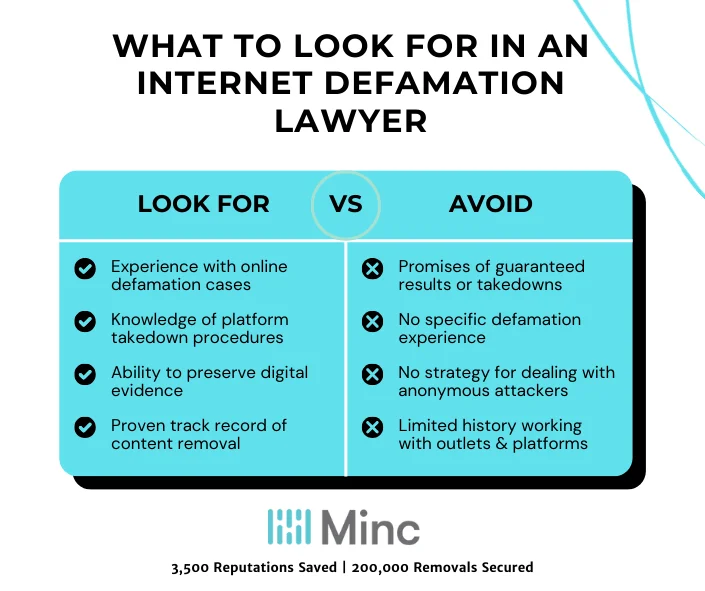
At Minc Law, we have extensive experience communicating with X (and previously Twitter) to remove defamatory content from their platform. We understand how protective they are of their users’ privacy and what it takes to uncover the identity of an anonymous defamer.
By knowing their processes and having points of contact within the platform, we can increase your chances of successfully removing defamatory posts.
Internet Attorneys Can File Defamation Lawsuits & Identify Anonymous Defamers
If X refuses to remove a post, we also know how to file a defamation lawsuit to obtain a court order to remove content. With the investigative tools at our disposal, we can help identify anonymous defamers, subpoena appropriate parties, and collect all relevant evidence.
Ultimately, we help clients take charge of the situation before defamation spirals out of control and causes irreparable damage.
Invasion of Privacy Tip: If your personal and protected information, like your social security number, driver’s license, or other sensitive information is shared online you should act quickly to get it removed. Most platforms have Terms of Service that prohibit the sharing of personal information, so you should flag the content for removal. If the website fails to remove the content, reach out to an experienced internet attorney to discuss other methods of content removal.
What Are Common Outcomes of Lawsuits Involving Defamation on X?
For many clients, their primary goal in filing a defamation lawsuit is to get the unwanted content removed from the internet. Content removal is a possibility if you obtain a court order after successfully proving defamation. Sometimes, just taking the action of filing a lawsuit is enough to convince some people to remove the defamatory content instead of defending a lawsuit.
If you have already suffered financial damages as a result of the defamation, you may also be able to recover damages with a lawsuit (although this adds to the time, complexity, and defamation lawsuit cost).
There are no guarantees as to specific outcomes in any type of lawsuit, and defamation lawsuits are no different. Success is in the eye of the beholder, the client.
Finally, defamation lawsuits may show the other party that you are serious about your online reputation. By filing a lawsuit, it may prevent the defamer from engaging in any future harassment or defamation.
Who Are Top Lawyers That Focus on Defamation on X (Formerly Twitter)?
We at Minc Law know the ins and outs of internet defamation. Our experienced internet defamation attorneys have helped clients remove over 200,000 pieces of unwanted online content.
We have also litigated defamation cases in 35 states and 5 countries, so we can help no matter where you are located.
We are well-versed in combating social media defamation, including libel and slander on X (formerly Twitter), as well as slander on Instagram, Youtube, Facebook, and most social media platforms. If you would like to schedule a no-obligation consultation to determine if you have a valid defamation claim related to X, contact us at (216) 373-7706 or fill out our contact form.
Get Your Free Case Review
Fill out the form below, and our team will review your information to discuss the best options for your situation.
This page has been peer-reviewed, fact-checked, and edited by qualified attorneys to ensure substantive accuracy and coverage.