(216) 373-7706
- Originally Published on January 26, 2026
What to Do If You Are the Target of LinkedIn Defamation

LinkedIn is a powerful tool for business owners and professionals. It can be used to make valuable connections, find jobs, and learn new information. However, it can also be a place where people post defamatory statements about other individuals, businesses, and professionals.
If you are the target of LinkedIn defamation, we recommend taking the following actionable steps:
- Do NOT respond to the defamer,
- Preserve and save the defamatory content by using a screenshot tool or preservation software,
- Report the defamatory content, profile, or conversation via LinkedIn’s reporting procedures,
- Block the user behind the offending profile,
- Send evidence preservation letters, and
- Work with an experienced internet defamation attorney to pursue legal action.
At Minc Law, we have considerable experience removing defamatory comments, posts, and profiles from social media platforms like LinkedIn. We work quickly and efficiently to remove harmful content without attracting any more unwanted attention, so our clients can move on with their lives.
What Qualifies as LinkedIn Defamation?
LinkedIn defamation occurs when someone posts a false, publicly visible statement on LinkedIn that harms an individual’s or company’s professional reputation. These are written statements, which means they fall under the category of libel rather than slander.
For a statement on LinkedIn to be actionable as defamation, it must meet specific legal criteria. The statement must be a false assertion of fact, not merely an opinion or general criticism. It must be publicly disseminated where others can see it, and it must target an identifiable person or business.
What Are the Requirements for Proving LinkedIn Defamation?
In most states, a plaintiff must prove the following four elements to have an actionable defamation claim:
- The defendant made a false statement about the plaintiff,
- The defendant communicated the false statement to a third party,
- The defendant acted with at least a negligent level of intent, and
- The defendant’s false statement caused damage to the plaintiff.
A False Statement of Fact
Someone must have made a false statement or assertion of fact about you or your business. A false statement is objectively untrue and not a matter of opinion. For example, stating “John was convicted of embezzlement” when no such conviction exists is a false statement of fact. However, saying “I believe John is unethical” is an opinion.
The statement must also identify the plaintiff or be reasonably understood to refer to the plaintiff.
Publication to a Third Party
The false statement must be communicated or published to a third party. Generally, statements posted on LinkedIn are presumed to be read by third parties, satisfying this requirement. False statements that are only seen by the plaintiff and the person who made them will not give rise to an actionable defamation claim.
Fault Amounting to At Least Negligence
A plaintiff must prove that the defendant communicated the statement with at least a negligent level of intent. This means they were careless when they made the statement and did not bother to determine whether it was actually true.
When defamation lawsuits involve a public figure or a matter of public concern, plaintiffs must prove that a defendant acted with actual malice or reckless disregard for the truth.
Damage to the Plaintiff’s Reputation
The plaintiff must prove that their reputation has been damaged as a result of the defamation. Damage can include lost business opportunities, termination of employment, loss of professional relationships, or other measurable harm to reputation.
Defamation vs. Free Speech on LinkedIn
Not every negative statement on LinkedIn qualifies as defamation. Criticism and negative opinions are protected forms of speech. The key distinction is whether the statement is a false assertion of fact or a protected opinion.
Protected statements include:
- Opinions (“I think this company has poor customer service”)
- Substantially true statements, even if unflattering
- Hyperbole that no reasonable person would take as fact
Defamatory statements include false accusations such as:
- “This person was fired for stealing from clients” (when untrue)
- “This company defrauded investors” (when no fraud occurred)
- “This professional had their license revoked” (when they remain licensed)
What is Defamation Per Se?
Defamation per se refers to statements that are so inherently harmful that damage to reputation is presumed. In cases of defamation per se, plaintiffs often do not need to prove actual damages.
In most states, statements fall into defamation per se when they:
- Accuse someone of committing a crime,
- Impute someone has a loathsome disease,
- Allege sexual misconduct, or
- State someone acted improperly in their profession, business, or trade.
On LinkedIn, defamation per se most commonly involves false accusations of professional misconduct. If someone falsely claims you committed fraud, were disbarred, lost your medical license, or engaged in other professional wrongdoing, you may have a claim for defamation per se.
What to Do If You Are Being Defamed on LinkedIn
If you discover defamatory content about you on LinkedIn, taking the right steps in the right order is critical. Here is what we recommend:
Do NOT Respond to the Defamer
Your initial impulse may be to respond or defend yourself. We strongly recommend against this. Responding to defamation can worsen the situation in several ways:
- It draws more attention to the defamatory content
- It can trigger the Streisand Effect, causing content to go viral
- It may open you up to legal liability if you make false statements in return
- It provides the defamer with more opportunities to attack you
Instead of responding publicly, take a deep breath and consult with a defamation attorney before taking any action.
Preserve and Document Everything
Defamatory statements can be deleted at any time by either the author or LinkedIn. If you want to pursue legal action, you will need evidence. Without documentation, you do not have a case.
Take the following steps immediately:
- Screenshot the defamatory posts, comments, or messages
- Capture the URL of the content
- Screenshot the profile of the person who posted it
- Note the date and time the content was posted
- Use preservation software like PageVault or VisualPing for additional documentation
- Save any related correspondence or evidence of damages
Report the Content to LinkedIn
LinkedIn has reporting procedures for content that violates their Professional Community Policies. While they may not remove all defamatory content without a court order, reporting violations is an important step.
How to Report a Post or Comment
- Click the three dots (More Icon) in the right corner of the post
- Click the flag (Report this post)
- Select the applicable reason from the Why are you reporting this? window
- Follow the prompts and click Submit
How to Report a Conversation
- Click the Messaging icon at the top of your LinkedIn page
- Select the message from the list
- Click the three dots in the top right and select Report this conversation
- Select the reason and follow the prompts
How to Report a Fake Profile
- Navigate to the profile you wish to report
- Click the More icon and select Report/Block
- Select the appropriate action and follow onscreen instructions
- Click Submit
After you report content, the user will not be notified of who reported them. LinkedIn’s team will review the report and may take action if the content violates their terms of service.
Block the User
After preserving evidence, consider blocking the user who posted the defamatory content. This prevents them from seeing or interacting with your profile and can reduce stress while you pursue other remedies.
Send Evidence Preservation Letters
If you are dealing with an anonymous poster, you may need to ask LinkedIn, the hosting platform, and internet service providers to preserve all information about the accounts in question. This prevents data from being deleted during their regular business operations.
An experienced internet attorney can help you draft and send proper evidence preservation letters to the relevant parties.
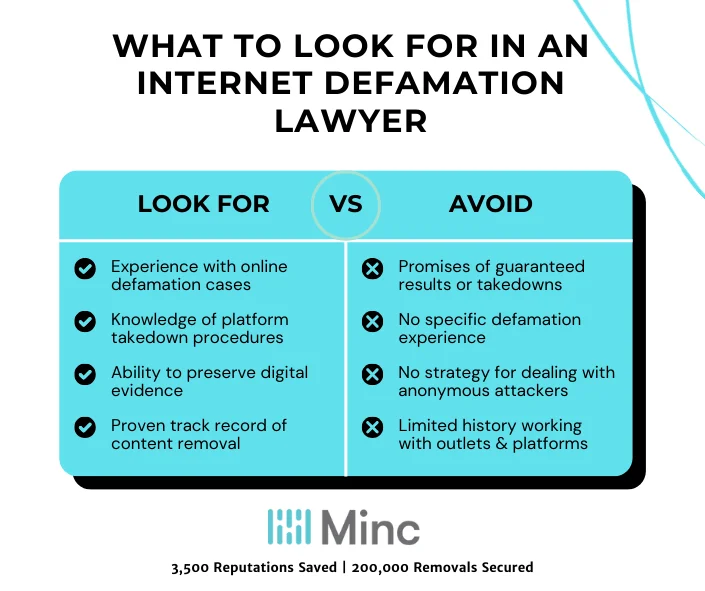
Consult an Experienced Internet Defamation Attorney
An experienced internet defamation attorney can evaluate your case and explain your options. They can help you:
- Determine if you have a valid defamation claim
- Send cease-and-desist letters
- File defamation lawsuits when necessary
- Identify anonymous defamers through “John Doe” lawsuits
- Obtain court orders for content removal
- Work with LinkedIn’s legal counsel to facilitate removal
Can You Sue LinkedIn for Defamation?
No, you generally cannot sue LinkedIn for defamatory content posted by users. Under Section 230 of the Communications Decency Act, internet service providers and platforms are immune from liability for content posted by third parties.
Section 230 protects platforms like LinkedIn from being held legally responsible for what users post. This means your legal recourse is typically limited to pursuing the individual who made the defamatory statements, not the platform itself.
Because of Section 230 protections, LinkedIn often requires a court order before removing user-generated content, even if that content is defamatory. They may remove content that clearly violates their Professional Community Policies, but they are not legally obligated to remove defamatory statements without a court order.
This is why many defamation cases involving LinkedIn require filing a lawsuit against the individual poster to obtain a court order mandating removal.
What is LinkedIn’s Harassment and Defamation Policy?
While LinkedIn does not have a specific defamation policy, their Professional Community Policies prohibit harassment and require users to be safe, trustworthy, and professional.
LinkedIn reserves the right to:
- Limit the visibility of certain content
- Remove content that violates their policies
- Suspend or terminate accounts for policy violations
If you are being harassed or have a safety concern, use LinkedIn’s contact form to report it directly to their team.
Legal Action for LinkedIn Defamation
When reporting to LinkedIn and sending cease-and-desist letters do not resolve the issue, legal action may be necessary.
Filing a Defamation Lawsuit
To pursue a defamation lawsuit over LinkedIn content, you will need to file suit against the individual who posted the defamatory statements, not against LinkedIn. Your attorney will need to prove the four elements of defamation discussed earlier in this article.
Identifying Anonymous Posters
If the person defaming you is anonymous or using a fake profile, you may need to file a “John Doe” lawsuit. These lawsuits allow you to subpoena LinkedIn and internet service providers to obtain identifying information about the anonymous user.
John Doe lawsuits can be expensive and time-consuming, but they are sometimes the only way to identify an anonymous defamer and hold them accountable.
Obtaining Court Orders for Removal
Once you have a favorable court judgment, you can use that order to compel LinkedIn to remove the defamatory content. Courts may also issue injunctions preventing the defamer from making additional defamatory statements.
Why Work With an Internet Defamation Attorney?
LinkedIn defamation cases require specialized knowledge of both defamation law and internet platforms. Here is why working with an experienced attorney matters:
Defamation Law is Complex and Nuanced
Defamation law is highly specialized, and internet defamation adds additional layers of complexity. Attorneys who focus on this area understand the nuances of proving defamation, navigating Section 230 protections, and obtaining effective remedies.
They Understand Technology and Investigation
Online defamers often mask their identities using VPNs, throwaway email accounts, and other anonymizing technologies. Experienced internet defamation attorneys have access to investigation tools and expertise needed to unmask anonymous attackers and preserve digital evidence properly.
They Know How to Avoid the Streisand Effect
Internet defamation attorneys understand how to remove content without drawing additional attention to it. They know how to handle situations discreetly to minimize the risk of triggering the Streisand Effect, where attempts to suppress information result in it receiving far more attention.
Protecting Yourself From LinkedIn Defamation
While you cannot prevent all defamation, you can take steps to protect yourself:
Monitor Your Online Presence
Set up Google Alerts for your name and business. Google Alerts notify you when new content mentioning your search terms appears online, allowing you to address problems quickly.
Adjust Privacy Settings
Review and adjust your LinkedIn and social media privacy settings. Be mindful of what you share publicly, as content can be taken out of context and used against you.
Build a Positive Online Presence
Create and maintain positive content about yourself and your business. A strong positive online presence can help suppress negative content and provides context that counters false narratives.
Respond Professionally When Appropriate
If you do choose to respond to negative content, do so professionally and carefully. Keep responses brief, factual, and non-defensive. If you are a medical professional, remember HIPAA restrictions on discussing patient information.
We Can Help With LinkedIn Defamation
At Minc Law, we have extensive experience removing defamatory content from LinkedIn and other social media platforms. We understand the technical, legal, and strategic considerations involved in addressing online defamation effectively.
We work efficiently to remove harmful content without attracting additional attention, allowing our clients to move forward with their personal and professional lives.
If you are facing defamation on LinkedIn, contact us for a no-obligation consultation with an intake specialist. Call (216) 373-7706 or fill out our contact form to discuss your situation and explore your options.
Get Your Free Case Review
Fill out the form below, and our team will review your information to discuss the best options for your situation.
This page has been peer-reviewed, fact-checked, and edited by qualified attorneys to ensure substantive accuracy and coverage.