(216) 373-7706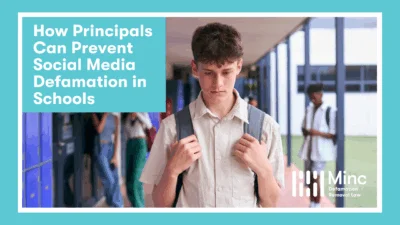
- Originally Published on October 27, 2025
How Principals Can Prevent Social Media Defamation in Schools

Social media has transformed how students interact. As a school principal, you are facing a challenge that did not exist a decade ago: students destroying each other’s reputations with false accusations that spread across Instagram, Snapchat, TikTok, and group chats before you know there is a problem.
At Minc Law, we have worked with families and schools dealing with social media defamation. We have seen students develop serious mental health issues over false rumors, families spend significant money on litigation, and school communities fractured by online attacks. The question is not whether your school will face this issue, but when.
Understanding Social Media Defamation in Schools
Before you can prevent social media defamation, you need to understand what it is and how it differs from typical cyberbullying.
What Makes Defamation Different from Cyberbullying
You have probably spent time developing anti-bullying policies. That is important work, but social media defamation requires a different framework.
Cyberbullying covers everything from mean comments to threats to exclusion tactics carried out online. Defamation is more specific. It involves a false statement of fact that is shared with others and damages someone’s reputation. The critical distinction is between opinion and fact.
When a student posts “I hate Sarah, she is so annoying,” that can be considered cyberbullying. When a student posts “Sarah had sex with three guys at the party last weekend” and it is false, that is defamation. The first expresses a feeling. The second makes a factual claim that can be proven true or false.
Understanding the difference helps you respond appropriately and educate your students about the legal risks they face when they spread false information online.
Common Forms of Defamatory Content
Certain patterns emerge repeatedly in school settings.
- False sexual misconduct allegations are common. A student might claim another student “hooked up with” multiple people, has a sexually transmitted infection, or engaged in sexual acts that never occurred. These rumors spread quickly and can follow students for years.
- Criminal activity accusations are also frequent. Students falsely claim their peers use or sell drugs, steal, cheat on tests, or engage in vandalism or violence.
- Anonymous “exposing” accounts have become particularly problematic. Students create Instagram or Snapchat accounts dedicated to sharing “secrets” about classmates, posting false information anonymously. They create rating or ranking accounts while hiding behind fake usernames. These formats embolden students to post things they would never say face-to-face.
- Reputation-destroying rumors include false claims about mental health crises, family problems, why someone changed schools, or personal hygiene. These can socially and psychologically isolate students.
The Real Consequences
The consequences extend beyond hurt feelings. Students can develop depression and anxiety, become socially isolated, experience academic decline, and in serious cases, self-harm.
Why Traditional Anti-Bullying Approaches Fall Short
Treating social media defamation as just another form of bullying means you are missing critical components of an effective response.
Traditional anti-bullying approaches focus on behavior modification and social-emotional learning. These remain important, but defamation requires legal knowledge that most programs do not provide. Your staff needs to understand what constitutes defamation versus protected speech, how to preserve evidence for legal proceedings, and when schools have authority to discipline off-campus conduct.
The legal stakes are different. Bullying typically results in school consequences like detention or suspension. Defamation can result in civil lawsuits where families seek monetary damages. The student who posts false accusations might find their family facing a lawsuit demanding substantial damages.
Evidence preservation is critical in ways it typically is not with bullying cases. Screenshots need timestamps and URLs. Content must be preserved before deletion. Most anti-bullying protocols do not address these requirements.
Schools’ legal authority to address off-campus online conduct is more limited than many administrators realize. (See Mahanoy Area School District v. B.L.)
Building an Effective Prevention Framework
Prevention is more effective than reaction. A comprehensive framework includes clear policies, robust education programs, and cultural initiatives.
Developing Clear, Specific Policies
Your student handbook needs to explain what defamation means in language students and parents understand. Provide concrete examples that illustrate the difference between hurtful opinions and false factual claims. Outline both school-based and potential legal consequences.
These policies need to navigate jurisdiction carefully. You cannot regulate all student speech off campus, but courts have held that schools can address off-campus conduct that substantially disrupts the school environment. Your policy should explain this standard clearly. (See Tinker v. Des Moines)
Implementing Student Education
Many students do not understand that their social media posts carry legal consequences. They think of Instagram and Snapchat as private conversations with friends, not as public publications that could land their families in court.
Students need regular, age-appropriate education about digital citizenship. They need to understand that defamation is a legal concept with real financial consequences. They need to learn the difference between fact and opinion, how quickly false information spreads online, and why they should not share unverified information about peers.
Start this education in middle school and continue through high school with increasingly sophisticated discussions. Consider bringing in attorneys who specialize in internet defamation to speak to students and parents. Hearing from legal professionals makes the consequences feel more real.
Students tune out abstract lectures. They engage with real examples and case studies. Discuss news stories about students whose lives were affected by false accusations. Walk through actual scenarios from your school community. Ask students to analyze social media posts and identify which cross the line.
Educating Parents About Their Role and Liability
Many parents do not monitor their children’s social media activity and may have no idea their child is spreading false rumors or being victimized by them. Host workshops that teach parents about the platforms their children use, how to monitor activity appropriately, and the potential for liability that exists in some states for the acts of minors (often under limited, state-specific parental responsibility statutes or negligence theories). (See overview at Justia – 50-State Parental Responsibility Laws)
Provide parents with practical tools for monitoring. Show them how to check their children’s social media accounts, what warning signs to look for, and how to have productive conversations about online behavior.
Building a Culture of Truth and Verification
Create a school culture that values truth and verification over viral content and gossip.
Teach students to pause before posting or sharing information about others. Encourage them to ask: Do I know this is true? Have I verified this information? Could this harm someone if it is false? Would I want this posted about me?
Create multiple reporting pathways including anonymous tip lines, trusted adult programs, and online reporting forms so every student has a way to raise concerns. When students do report, respond quickly and take their concerns seriously.
Communicate proactively about school policies, safety protocols, and general disciplinary approaches. This reduces the information vacuums where false rumors grow. When rumors do circulate, address them promptly with factual information.
Responding Effectively When Defamation Occurs
Despite prevention efforts, you will face social media defamation situations. How you respond in the first hours and days matters.
Preserve Evidence Immediately
When a student or parent reports possible defamation, document the content before investigating. Take screenshots that show the full post, any comments, the date and time stamp, the platform, and the account that posted it. Save these in multiple locations. If the content is in a video or story that will expire, record it.
Train multiple staff members on proper evidence preservation. Create a simple checklist: screenshot with timestamp visible, save the URL, document who shared it and how many people have seen it, note any comments or shares.
Assess the Situation
Not every mean post requires full-scale intervention. Consider whether the statement is actually false or an unpleasant opinion. Evaluate how widely the content has spread and whether it is gaining traction or dying out. Think about the potential for real harm to the target student’s reputation, safety, and well-being.
Sometimes the best response is supporting the target student while allowing minor incidents to fade naturally, especially when content has limited reach and the poster quickly deletes it. When false statements are spreading widely or making serious accusations, immediate action is necessary.
Conduct a Thorough Investigation
Interview the target student privately to understand what is being said and how it is affecting them. Speak with witnesses who have seen the content. Talk with the student accused of posting defamatory content. Document everything carefully.
During investigations, be careful about discussing the content with other students. You do not want to spread the false information further. Focus on gathering information about what was posted, who saw it, how widely it spread, and what impact it had.
Implement Appropriate Consequences
Your response should be proportional to the severity. Minor incidents involving quickly deleted posts with limited spread might warrant a conference with the posting student and their parents, education about defamation and its consequences, and a requirement to post a retraction or apology.
More serious situations involving widespread false accusations might require suspension, removal from activities or positions of leadership, and referral to law enforcement if the content involves threats or criminal allegations.
Consider restorative justice approaches alongside traditional discipline. Having the posting student meet with the victim to understand the harm they caused can be more effective than suspension alone.
Support the Target Student
Provide counseling services, safety planning if there are concerns about escalation, academic accommodations if their schoolwork is suffering, and help with social reintegration if they have been isolated by false rumors.
Check in with target students regularly in the weeks and months following defamation incidents. The psychological effects often linger.
Working with Families and Legal Proceedings
In serious defamation cases, families often want to pursue the removal of content and potentially legal action.
Platform Reporting
Many major social media platforms provide mechanisms to report alleged defamation or abusive content (for example, Instagram offers a defamation reporting form; Snapchat provides in-app abuse reporting). (See Instagram’s form: Instagram Defamation Reporting)
Be realistic with families about limitations. In the United States, online platforms are generally immune from being treated as the publisher of user posts under Section 230 of the Communications Decency Act and therefore are typically not legally required to remove content upon notice, even if alleged to be defamatory (though platforms may choose to remove it). (See CRS Report on Section 230)
When Families Pursue Legal Action
Balance supporting the victim with maintaining neutrality in what may become litigation involving multiple students and families. Be prepared to cooperate with legal discovery requests, which may include providing records of your investigation and disciplinary actions taken.
Be clear about what the school can and cannot do legally. You can discipline students according to school policy, but you generally cannot sue students on behalf of other students or force families to pursue legal remedies.
Connecting Families with Experienced Legal Counsel
Connect families dealing with serious defamation to attorneys who have experience in this area. At Minc Law, we work with families navigating social media defamation, and early legal intervention can often resolve situations before they require expensive litigation.
Understanding Your Legal Boundaries
One of the most challenging aspects is understanding where your authority ends and where you might violate students’ constitutional rights.
The Tinker Standard
The foundational case for student speech rights is Tinker v. Des Moines. The Supreme Court held that schools may restrict student speech when it would cause a material and substantial disruption to school operations or impinge upon the rights of others. (See ACLU – Tinker Overview) This standard still applies.
The key is documenting substantial disruption. Your investigation should record how the defamatory content affected school operations. Did it require staff time to address? Did it interfere with educational activities? Did it create safety concerns? Did it prevent students from learning effectively? This documentation helps justify your authority to act under Tinker v. Des Moines.
Recent Supreme Court Guidance on Off-Campus Speech
In 2021, the Mahanoy Area School District v. B.L. case involved a student who posted criticism of her school’s cheerleading team on Snapchat over the weekend. The Court held that while schools can sometimes regulate off-campus speech, they generally have less authority to do so than over on-campus speech. (See K-12 Legal Insights – Mahanoy Summary)
This does not mean you are powerless to address off-campus social media defamation. Courts recognize that schools can address off-campus conduct that causes substantial disruption to the school environment. When false accusations posted over the weekend result in Monday morning chaos, you likely have authority to intervene under Tinker v. Des Moines and consistent with Mahanoy Area School District v. B.L.
Preparing for Crisis Situations
Every principal should have a predetermined crisis response plan for serious social media defamation situations.
Your crisis response team should include yourself and relevant assistant principals, your district’s legal counsel or a retained attorney, your school counselor or psychologist, your school resource officer or security personnel, and your communications director.
This team should meet at the beginning of each school year to review protocols and ensure everyone understands their role. They should have established communication channels for rapid response outside school hours, since defamation crises often erupt on weekends or evenings.
Your plan should address evidence preservation procedures, investigation protocols that protect due process, communication templates for notifying parents, safety planning procedures for high-risk situations, and coordination protocols with law enforcement when necessary.
Do not wait until you are in crisis to establish relationships with legal counsel who understand both education law and internet defamation. Schools that have existing relationships with specialized counsel respond more effectively.
We Are Here to Help
At Minc Law, we have dedicated our practice to helping families, schools, and individuals navigate online defamation and digital reputation issues. We understand how complex and sensitive these situations can be for educators and school leaders.
Our team has worked with schools in the Cleveland area and beyond to help educate communities about responsible digital behavior. We also offer limited speaking opportunities and informational sessions for school administrators and parent groups interested in learning more about social media defamation and online safety.
Social media defamation is one of the most challenging issues facing school principals today, but you do not have to navigate it alone. With the right knowledge and guidance, you can respond effectively and foster a healthier online culture for your students.
About Minc Law
Minc Law is a law firm with deep experience in internet defamation, online reputation management, and digital privacy. Our attorneys have extensive experience representing defamation victims, working with schools and educational institutions, and navigating the intersection of student speech rights, school authority, and defamation law.
For more information about our services or to schedule a consultation or speaking engagement, visit our website or contact us directly.
This article is provided for informational purposes only and does not constitute legal advice. School administrators facing specific defamation situations should consult with qualified legal counsel.
Get Your Free Case Review
Fill out the form below, and our team will review your information to discuss the best options for your situation.
This page has been peer-reviewed, fact-checked, and edited by qualified attorneys to ensure substantive accuracy and coverage.