(216) 373-7706
- Originally Published on February 4, 2026
Google Review Defamation Lawsuit: When and How to Sue Over a False Review

When a false Google review crosses the line from criticism into defamation, many business owners ask the same question: Can I sue?
The answer is often yes. But whether you should sue depends on several critical factors, including the severity of the harm, the identity of the reviewer, their ability to pay damages, and whether other remedies have failed.
If you have reached the point where you are seriously considering legal action, you are likely dealing with more than just a negative opinion. You are facing false statements that are damaging your reputation, costing you customers, and threatening your livelihood. This guide will walk you through everything you need to know about filing a Google review defamation lawsuit.
In this guide, you will learn:
- When a Google review becomes legally actionable defamation
- The legal elements you must prove to win your case
- What to expect during the lawsuit process
- What damages you can recover
- Why Section 230 protects Google but not the reviewer
- When to hire an experienced defamation attorney
At Minc Law, we have successfully represented hundreds of businesses in defamation cases involving fake and false Google reviews. We understand the unique challenges these cases present and have a proven track record of obtaining favorable outcomes for our clients.
When Does a Google Review Count as Defamation?
Not every negative Google review is defamatory. In fact, most are not. Customers have a legal right to share their honest opinions and experiences, even when those opinions are harsh or unfavorable to your business.
However, when a review contains false statements of fact that harm your reputation, it may constitute defamation. Understanding the distinction between protected opinion and actionable defamation is the first step in determining whether you have grounds for a lawsuit.
The Legal Elements of Defamation
To succeed in a Google review defamation lawsuit, you must prove the following elements:
1. False Statement of Fact
The review must contain a statement that can be proven false. Vague opinions like “terrible service” or “I had a bad experience” are generally protected speech. But specific factual claims such as “they stole my credit card information,” “the owner is a convicted felon,” or “they never delivered my order despite charging me” can be defamatory if false.
2. Publication to a Third Party
The false statement must be communicated to at least one other person. Posting a review on Google satisfies this requirement automatically, as reviews are public and visible to anyone searching for your business.
3. Fault (Negligence or Actual Malice)
You must demonstrate that the reviewer acted with at least negligence in making the false statement. In some cases, especially when the business is well-known or the statement involves matters of public concern, you may need to prove “actual malice,” meaning the reviewer knew the statement was false or acted with reckless disregard for the truth.
4. Harm to Reputation and Damages
You must show that the false review damaged your business’s reputation and resulted in actual harm. This could include lost customers, decreased revenue, cancelled contracts, or other measurable impacts. Actual damages are critical. Vague or speculative harm is generally not enough to support a defamation claim.
Some statements are considered so harmful that damages are presumed. These fall under “defamation per se” and typically involve accusations of:
- Criminal activity
- Sexual misconduct or immoral behavior
- Having a loathsome disease
- Professional incompetence or misconduct
Defamation Per Se vs. Defamation Per Quod
Understanding the difference between these two types of defamation is important when evaluating your case.
Defamation per se involves statements that are so obviously harmful that damages are presumed. You do not need to prove specific financial losses. The harm is inherent in the accusation itself.
Defamation per quod (or implied defamation) involves statements that may not appear harmful on their face but become defamatory when considered alongside additional facts or context. These cases require you to prove “special damages,” which are concrete, measurable financial losses.
For example, a series of coordinated one-star reviews with no text might constitute defamation per quod if you can prove they were part of a targeted campaign by a competitor and resulted in quantifiable business losses.
When Is a Defamation Lawsuit The Right Choice?
Filing a defamation lawsuit is a serious decision that comes with costs, time commitments, and strategic considerations. Before pursuing litigation, you should carefully evaluate whether a lawsuit is appropriate for your situation.
You Should Consider a Lawsuit When:
The Review Contains Clear, Provably False Statements
If the review makes specific factual claims that you can definitively disprove with evidence such as transaction records, communications, or other documentation, you have a stronger foundation for a defamation case.
You Have Suffered Measurable Financial Harm
Can you quantify the damage? Have you lost specific clients, contracts, or revenue that can be directly traced to the false review? The more concrete your damages, the stronger your case.
Other Remedies Have Failed
Have you tried flagging the review to Google? Did you attempt to contact the reviewer directly? If platform reporting and direct resolution efforts have been exhausted without success, litigation may be your best remaining option.

The Reviewer Has Assets or Insurance
This is perhaps the most overlooked but critical consideration. Even if you win a defamation lawsuit and are awarded significant damages, collecting on that judgment can be difficult if the defendant has no money or assets. We call this “judgment worthiness,” and it is a key factor in deciding whether to sue.
However, if the reviewer is a business competitor, former employee, or professional with insurance coverage, your chances of recovery improve significantly.
The Review Is Part of a Pattern of Harassment
If you are dealing with a coordinated attack, multiple fake reviews from the same person, or ongoing harassment that extends beyond a single review, legal action may be necessary to stop the conduct and deter future attacks.
When a Lawsuit May Not Be the Best Option:
- The review is vague or clearly opinion-based
- You cannot identify the reviewer and have limited means to do so
- The financial damages are minimal or speculative
- The reviewer has no assets or ability to pay damages
- Litigation would draw more attention to the review (Streisand Effect)
- The cost of litigation outweighs the potential recovery
An experienced defamation attorney can help you conduct a thorough cost-benefit analysis and determine whether litigation makes strategic and financial sense for your situation.
How Does a Google Review Defamation Lawsuit Work?
If you have decided that a lawsuit is the right course of action, understanding the legal process will help you prepare for what lies ahead.
Step 1: Pre-Litigation Demand and Retraction Request
Before filing a lawsuit, your attorney will typically send a formal demand letter to the reviewer. This letter:
- Identifies the false and defamatory statements
- Explains why the statements are legally actionable
- Demands removal of the review and, in some cases, a public retraction
- Warns of potential legal action if the reviewer does not comply
In some states, sending a retraction demand is legally required before you can seek punitive damages in a defamation case. Even when not required, a demand letter can resolve the issue quickly and cost-effectively. Many reviewers, once confronted by an attorney, choose to remove the review rather than face litigation.

Step 2: Filing the Complaint
If the reviewer refuses to remove the review or does not respond to the demand, the next step is filing a formal complaint in court. Your complaint will:
- Identify the parties involved
- Describe the defamatory statements in detail
- Explain how the statements are false
- Outline the harm you suffered
- Specify the legal claims you are bringing
- State the damages you are seeking
At this stage, if the reviewer is anonymous or using a fake name, your attorney may file what is known as a John Doe lawsuit. This allows you to proceed with litigation even when the identity of the defendant is unknown.
Step 3: Obtaining a Subpoena to Identify Anonymous Reviewers
One of the biggest challenges in Google review defamation cases is identifying the person behind an anonymous or pseudonymous account. To do this, your attorney will request court approval to issue subpoenas to:
- Google (to obtain account information, IP addresses, and device data)
- Internet service providers (to link IP addresses to physical subscribers)
- Other third parties who may have identifying information
This process requires carefully crafted legal arguments demonstrating that you have a valid defamation claim and that the information sought is necessary and relevant.
Successfully identifying an anonymous reviewer is often the turning point in these cases. Once the individual is unmasked, many choose to settle rather than proceed with costly litigation.
Step 4: Discovery and Evidence Gathering
During the discovery phase, both sides exchange information and evidence. This may include:
- Business records showing financial impact
- Communications with customers or employees
- Documentation of prior disputes with the reviewer
- Testimony from witnesses
- Expert analysis of damages
Your attorney will also depose the defendant, requiring them to answer questions under oath about the review, their motivations, and the accuracy of their statements.
Step 5: Settlement Negotiations
The majority of defamation lawsuits settle before trial. Once the defendant realizes the strength of your case, the costs of continuing litigation, and the risk of a large damages award, they often become more willing to negotiate.
A settlement may include:
- Removal of the defamatory review
- A written retraction or apology
- Monetary compensation for damages
- A legally binding agreement not to post further defamatory content
Step 6: Trial and Judgment
If settlement is not possible, your case will proceed to trial. You will present evidence, call witnesses, and argue your case before a judge or jury. If successful, the court may award:
- Compensatory damages for actual financial losses and reputational harm
- Punitive damages if the defendant acted with malice or egregious conduct
- Injunctive relief, including a court order requiring removal of the review
- Attorney fees and costs, depending on state law and the circumstances of the case
Can I Sue Google for a Defamatory Review?
Many business owners wonder: Why cannot I just sue Google for hosting the defamatory review?
The answer lies in Section 230 of the Communications Decency Act (CDA), a federal law that provides broad immunity to online platforms for content posted by third-party users.
What is Section 230 of the Communications Decency Act?

Under Section 230, Google is not considered the “publisher” of reviews posted by users, which means Google generally cannot be held liable for defamatory content, even if they refuse to remove it after you report it.
There are limited exceptions to Section 230 immunity, including:
- Federal criminal law violations
- Intellectual property infringement (copyright, trademark)
- Content that the platform itself created or materially contributed to
For this reason, defamation lawsuits must target the individual who posted the review, not Google. However, Google can still be compelled to produce identifying information about the reviewer through a valid subpoena, and a court can order Google to remove content pursuant to a final judgment.
Why You Need an Experienced Defamation Attorney
Google review defamation cases involve complex legal issues at the intersection of internet law, defamation law, and civil procedure. Attempting to handle these cases without experienced counsel can result in:
- Procedural missteps that get your case dismissed
- Failure to properly identify anonymous reviewers
- Inadequate evidence of damages
- Missed deadlines and lost legal rights
- Exposure to anti-SLAPP motions (in some states) that could require you to pay the defendant’s attorney fees
An attorney experienced in online defamation and internet law brings critical advantages:
- Knowledge of platform policies and legal procedures for unmasking anonymous users
- Expertise in drafting effective demand letters that achieve results without litigation
- Strategic guidance on when to settle and when to fight
- Proven track record of successfully litigating defamation cases
- Resources and relationships to efficiently gather evidence and retain experts
- Understanding of anti-SLAPP laws and how to navigate them successfully
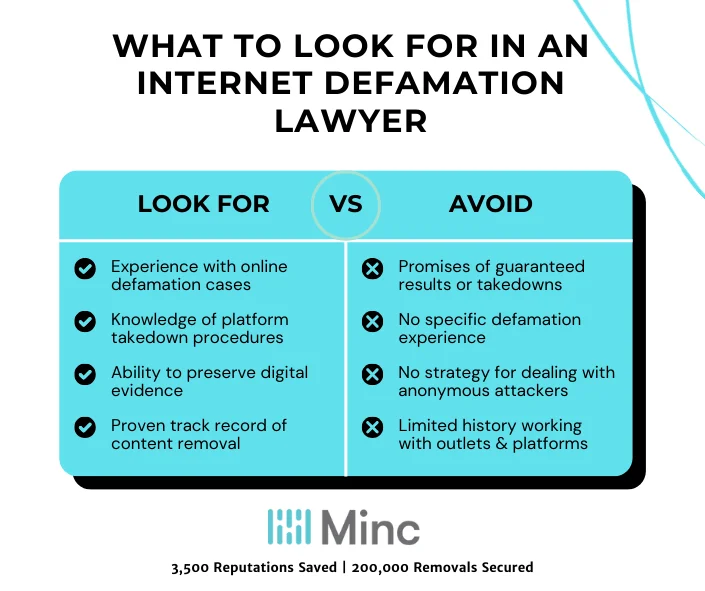
At Minc Law, we focus exclusively on online defamation, reputation management, and internet law. We have handled hundreds of cases involving fake reviews, defamatory content, and online harassment. Our attorneys understand the nuances of these cases and have the experience to achieve results.
FAQs About Google Review Defamation Lawsuits
What Damages Can You Recover in a Google Review Defamation Lawsuit?
Understanding what you can potentially recover helps set realistic expectations and guides your decision on whether to pursue litigation.
- Actual Damages Also called compensatory damages, these are designed to make you whole for the harm you suffered. They may include lost profits and business revenue, lost customers or contracts, damage to professional reputation, costs of reputation repair and management services, emotional distress and mental anguish (in some jurisdictions)
- Punitive Damages In cases where the defendant acted with actual malice, fraud, or willful misconduct, courts may award punitive damages to punish the wrongdoer and deter similar conduct by others. Punitive damages can significantly exceed actual damages, but many states have caps or restrictions on when they can be awarded.
- Injunctive Relief A court order requiring the defendant to remove the review and refrain from posting similar content in the future is often one of the most valuable outcomes. This prevents ongoing harm and provides enforceable legal protection.
- Attorney Fees and Costs Some states allow prevailing parties in defamation cases to recover their attorney fees and litigation costs. This can make pursuing a case more financially viable, especially when damages are moderate but the principle and need for removal are important.
How much does it cost to sue someone for a defamatory Google review?
The cost varies depending on the complexity of the case, whether the reviewer is anonymous, and whether the case settles or goes to trial. Legal fees can range from several thousand dollars for straightforward cases to $50,000 or more for complex litigation. Many defamation attorneys, including Minc Law, can provide cost estimates during your initial consultation.
How long does a Google review defamation lawsuit take?
Simple cases that settle quickly may resolve in a few months. Cases requiring identification of anonymous reviewers and extensive litigation can take one to two years or longer. The timeline depends on court schedules, the defendant’s willingness to settle, and procedural complexity.
What if I do not know who posted the fake review?
Your attorney can file a John Doe lawsuit and subpoena Google and internet service providers to obtain identifying information. This process requires specific legal procedures and court approval, but it is a common and often successful approach in online defamation cases.
Can I sue for a one-star review with no text?
In most cases, a wordless one-star review is considered opinion and is not actionable as defamation. However, if you can prove the review is part of a coordinated attack or campaign that has caused measurable harm, you may have a claim for implied defamation (defamation per quod) or other causes of action.
Will suing make the problem worse (Streisand Effect)?
This is a valid concern, and it is something your attorney should carefully consider before proceeding. In many cases, defamation lawsuits are resolved confidentially through settlement, minimizing public attention. Your attorney can help assess the risk and determine whether litigation is likely to help or harm your situation.
What if the reviewer is a competitor?
If you have reason to believe an industry competitor posted the fake Google review, you may be able to pursue additional claims beyond defamation, including false advertising, unfair competition, and business disparagement. A cease and desist letter is often an effective first step.
Take Action Now to Protect Your Business and Reputation
If you are dealing with a defamatory Google review that is harming your business, time is of the essence. The longer the false content remains online, the more damage it can do to your reputation and bottom line.
At Minc Law, we offer confidential consultations to evaluate your situation, explain your legal options, and develop a strategic plan tailored to your needs and goals. We have successfully represented businesses across industries in removing defamatory content and holding wrongdoers accountable.
Our services include:
- Comprehensive case evaluation and strategy development
- Pre-litigation demand letters and retraction requests
- Filing and litigating defamation lawsuits
- Identifying anonymous reviewers through subpoenas and discovery
- Negotiating favorable settlements
- Obtaining court orders for content removal
- Protecting your business from future attacks
Do not let a false review destroy what you have worked so hard to build. Contact Minc Law today to discuss your Google review defamation lawsuit options.
If you are ready to speak with an internet defamation attorney, you can reach the Minc Law team by calling us at (216) 373-7706, or by contacting us via Chat, email, or our online contact form below.
Get Your Free Case Review
Fill out the form below, and our team will review your information to discuss the best options for your situation.
This page has been peer-reviewed, fact-checked, and edited by qualified attorneys to ensure substantive accuracy and coverage.