 (216) 373-7706
- Originally Published on July 15, 2025
How to Remove a Fake Google Review

Fake Google reviews can seriously damage your business’s reputation, drive away potential customers, and lead to lasting financial harm. Fortunately, there are proven strategies to respond to and remove fake Google reviews, whether they come from a disgruntled customer, a competitor, a former employee, or an anonymous troll.
Negative and fake Google reviews happen to nearly every business. What matters most is how you respond. Taking the right steps early can limit the damage, protect your reputation, and increase your chances of having the review removed.
In this guide, you will learn how to:
- Spot the telltale signs of fake Google reviews
- Engage effectively and professionally with the reviewer (or not at all)
- Use Google’s reporting system the right way
- Escalate with legal strategies like DMCA notices, cease and desist letters, or defamation lawsuits
- Understand when it’s time to bring in an attorney
At Minc Law, we have helped hundreds of businesses remove false and damaging reviews from Google and other consumer platforms. We regularly assist clients in responding to fake reviews, identifying anonymous posters, and exploring their legal options.
Minc Law Video Resource: How to Remove Fake Google Reviews
Identifying Fake Google Reviews
Determining whether a Google review is fake often starts with a gut feeling. You know your business, your clients, and the interactions you have with them. When a review doesn’t match up with any known customer records or sounds oddly generic or hostile, it is worth digging deeper.
Begin by comparing the review’s content to your business records. Can you verify that the person who left the review actually interacted with your company? If there is no matching transaction, appointment, or record, this alone raises suspicion.
You should also inspect the reviewer’s Google account. A review left by an account created that same day, with no other activity or reviews, is often a red flag. So are usernames that look made-up or profile photos that resemble stock images. In fact, you can perform a reverse image search on Google to check if the profile picture appears elsewhere online.
Suspicious timing can also signal fake activity. For example, a sudden influx of one-star reviews overnight or a coordinated surge of negativity might indicate a review campaign by bots or paid reviewers. Pay attention to the language of the reviews as well. Fake reviews often use over-the-top accusations, inaccurate descriptions, or promote your competitor either directly or subtly.
As a business, it is crucial that you closely monitor your online presence and have a clear understanding of which reviews are genuine and which are fabricated. What makes a review suspicious varies from case to case, so the best advice is to trust your intuition.
How Fake Google Reviews Can Impact Your Business
Nearly everyone consults reviews before using a business. In fact, approximately 90% of global consumers prefer to read reviews before purchasing a product. And half of consumers trust online reviews as much as personal recommendations.
However, numerous review platforms are available. How does Google stack up when consumers are searching out online reviews?
The answer is that Google is extremely popular. It is the most widely used review platform, with 60% of consumers using it to read reviews. The importance of online reviews (and Google reviews) and the effect they can have on a business’s success and longevity cannot be overstated.
How to Remove Fake Google Reviews
If a reviewer is determined to leave a fake Google review for your business, they may use one of several methods. For instance, they may:
- Post as multiple people and post multiple reviews.
- Leave a one-star review with no text.
- Post statements that are blatantly false; or
- Leave a review made up of mixed substantive truths and falsities.
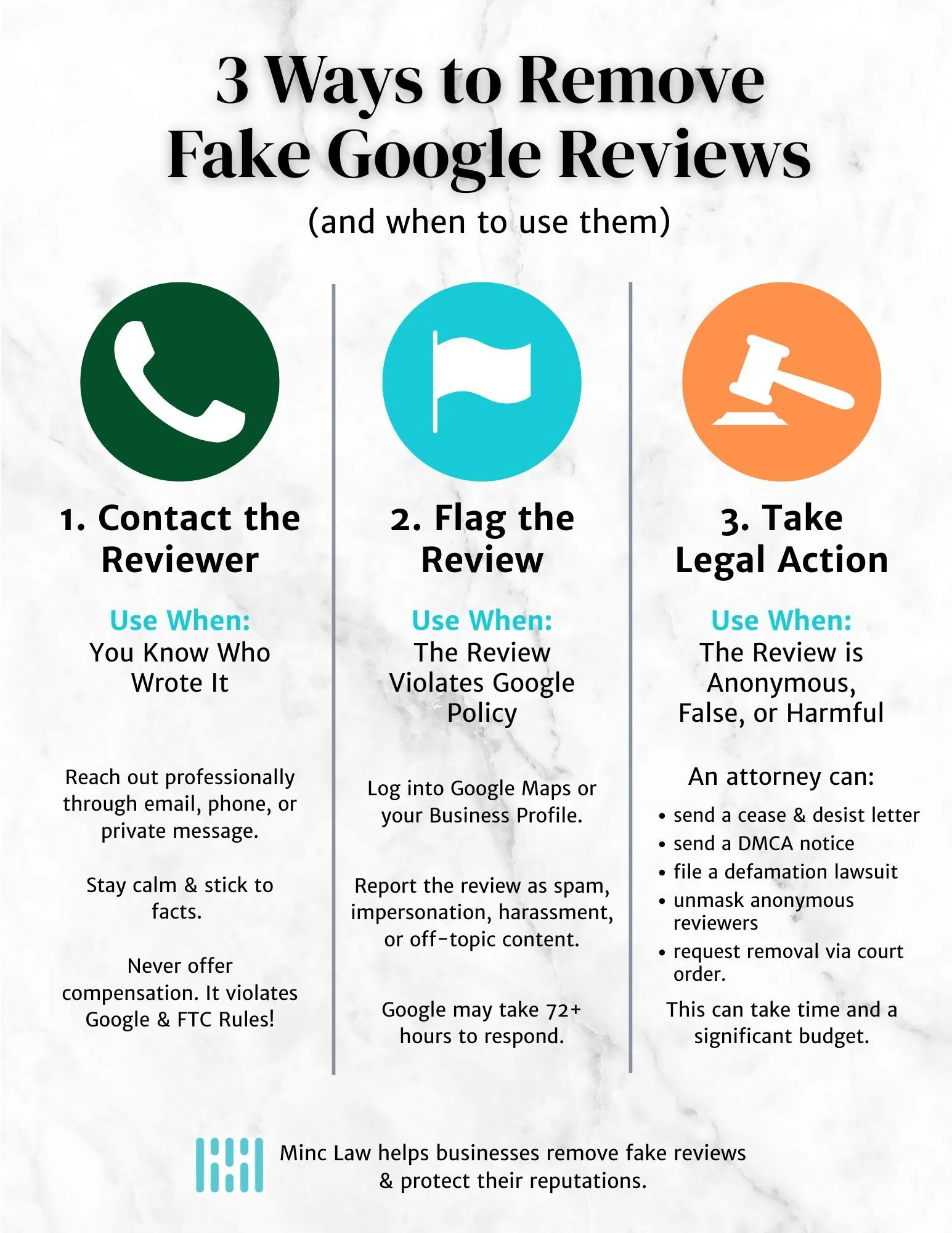
Whatever form the review takes, you have options to fight back. Below, we cover the three strategies you can use to remove fake reviews.
Option #1: Have the Original Author Remove the Review
Even when a review is clearly fake or left in bad faith, it may still be productive to contact the author directly and request that it be removed. This step is not about admitting fault or validating the review; it is simply a strategic way to resolve the situation quickly, without relying on reporting systems or third parties.
If the reviewer is identifiable, consider reaching out to them through private channels, such as phone, email, or direct message. Begin by acknowledging the feedback and clearly stating that your business takes all concerns seriously. Even if the content is inaccurate or fabricated, starting from a place of professionalism and empathy may reduce hostility and increase the likelihood of cooperation.
Whenever possible, we recommend a phone call over a written message. Turning an impersonal situation into a direct conversation can help de-escalate tension and reinforce that your business is willing to engage professionally. If a call is not possible, offer another direct line of communication, such as a private message or email.
Public responses should be avoided unless absolutely necessary. Responding publicly can bring more attention to the review, reduce the chances of it being removed by the platform, and in some cases, invite more negative reviews. A poorly worded reply can also expose businesses to legal risks, especially for professionals such as doctors or lawyers who are bound by confidentiality and privacy obligations.
Google Review Tip: Never offer compensation or incentives in exchange for removing or modifying a review. Doing so not only violates Google’s policies, but may also be considered deceptive under FTC guidelines and could expose your business to legal consequences.
This step is not appropriate for every situation. If the reviewer is anonymous or unresponsive, it may not be effective. But when there is a chance the reviewer can be reached and influenced, this is a low-risk first step that should not be overlooked.
Option #2: Flag and Report the Review
Flagging a fake Google review is the first step towards having Google remove false online reviews. Think of it as sending a signal to Google to alert them, “Hey! Something is not quite right here. Please come take a look!”
However, before pulling the trigger, always check Google’s review guidelines first to determine what Google considers an inappropriate review. Google’s policies prohibit the following types of reviews:
- Spam and fake content;
- Off-topic content (such as posts unrelated to the location or business in question);
- Restricted content (such as links or contact information for where consumers can buy illegal goods or services)
- Illegal, sexually explicit, and/or terrorist content;
- Offensive and obscene language and gestures;
- Dangerous and derogatory content (such as harassment or threats of physical violence/harm);
- Brand impersonations (such as trademark infringement, unfair competition, and deceptive trade practices by other businesses); and
- Conflicts of interest (such as reviews written by the business’s owner, current or former employees, or competitors).
How to Flag a Google Review
You can flag a review through two primary channels: Google Maps or your Google Business Profile.
Flag via Google Maps:
- Search for your business on Google Maps.
- Locate the review in question.
- Click the three vertical dots next to the review.
- Select “Report review” and follow the prompts.
Flag via Google Business Profile:
- Sign in at business.google.com.
- Choose the location (if you manage multiple).
- Navigate to the “Reviews” tab.
- Find the review and click the three dots next to it.
- Select “Report review” and submit your reason.
What to Expect After Flagging the Review
After flagging the review, Google will typically send an email confirming that it’s being reviewed. The process may take up to 72 hours. If Google agrees that the review violates policy, it will be removed. If not, the review will remain live.
Unfortunately, many fake reviews fall into gray areas that Google refuses to act on. Still, flagging is essential to document your attempts and escalate further if needed.
Bonus Tip: Tweet @GoogleSmallBiz While not guaranteed, tweeting at @GoogleSmallBiz can sometimes prompt a faster response, especially if you’ve already exhausted other options.
Option #3: Pursue Legal Action
If a fake review is harming your business and platform reporting has failed, it may be time to consider legal action. While lawsuits are not always necessary, the threat of legal intervention can often resolve the situation quickly, especially when a reviewer is trying to stay anonymous or avoid responsibility.
Cease and Desist Letters
A common first step is sending a cease and desist letter. This formal legal notice alerts the reviewer that their content may be unlawful and provides them with an opportunity to voluntarily remove the review before facing potential legal consequences. In many cases, reviewers back down after receiving a letter from an attorney.
Retraction Demands
In some states, a retraction demand is required before filing a defamation lawsuit, particularly if you intend to seek punitive damages. This formal request asks the reviewer to retract or correct their statement. Even when not legally mandated, a retraction demand can show that you attempted to resolve the issue amicably and can strengthen your legal position if litigation becomes necessary.
DMCA Takedowns
If the review includes stolen or unauthorized use of your intellectual property, such as reposted content, logos, or media, you may also have grounds to file a DMCA takedown notice. This can be an effective tool for rapid removal, especially if the content infringes on your copyrights.
Litigation and Court Orders
If a fake review contains defamatory claims, impersonation, harassment, or extortion, pursuing legal action may be appropriate. Litigation allows you to take formal steps to identify the reviewer, stop the harmful conduct, and potentially recover damages.
If the reviewer is anonymous, your attorney can file a John Doe lawsuit and request a subpoena to obtain identifying information from platforms or internet service providers. Once the individual is identified, you may seek compensation for reputational or business harm and request a legally binding court order to have the review removed.
Courts may also issue other types of orders depending on the circumstances, including:
- Injunctions to stop ongoing harmful behavior or prevent further posting
- Content removal orders directed at platforms (such as Google or Yelp)
- Restraining orders in cases involving harassment or threats
Litigation can be a powerful tool, but it carries potential downsides. Legal cases may take time, involve costs, and in some instances draw more attention to the harmful content, a phenomenon known as the “Streisand Effect.” Most lawsuits involving fake reviews are resolved before trial, but the decision to sue should always be made in consultation with an experienced defamation attorney who can assess the risks and benefits.
Frequently Asked Questions about Removing Google Reviews
Can You Sue Over a Wordless One-Star Fake Google Review?
In most cases, one-star reviews are considered expressions of opinion. But not always. Since defamation must contain a false statement of fact, a wordless review is generally not actionable as defamation per se, and would have to take into account other external facts that make the review actionable. These types of claims are referred to as defamation per quod or implied defamation. However, whether you can sue for a one-star review is dependent on many specific factors.
If your business experiences a series of seemingly connected one-star reviews, for example, you may be able to sue the poster.
What Should I Do If Google Doesn’t Take the Review Down?
If your flag is ignored or the review remains live despite violating Google’s guidelines, you still have options. In some cases, businesses may choose to escalate the matter by sending a formal legal notice or pursuing more comprehensive remedies. This is where experienced legal help can make a real difference.
What If I Suspect the Reviewer is a Competitor?
If you have reason to believe an industry competitor posted the fake Google review in question, you can try sending them a cease-and-desist letter. If that does not work, you may be able to file a defamation lawsuit against them if there are numerous causes of action, such as:
- False advertising claims
- Injurious falsehood (business disparagement)
- Unfair/deceptive trade practices
What If I Don’t Know Who Posted the Review?
Many fake reviews are posted anonymously or under fake names. In such cases, attorneys can file a lawsuit known as a “John Doe” lawsuit to uncover the identity of the person behind the review. Once identified, legal action becomes possible and can lead to removal or resolution.
We Can Help You Remove Fake Google Reviews & Damaging Content
If you are in business long enough, you are likely to encounter fake online reviews. It is just the name of the game. How you respond to fake reviews and approach their removal is what will separate your business from competitors and enable your business to stand the test of time in your industry.
At Minc Law, our practice is dedicated to removing fake online reviews and other defamatory internet content. We know what it takes to not only remove fake online reviews but also put an end to online attacks for good, helping your business present its best digital footprint.
If you are ready to speak with an internet defamation attorney, you can reach the Minc Law team by calling us at (216) 373-7706, or by contacting us via Chat, email, or our online contact form below.
Get Your Free Case Review
Fill out the form below, and our team will review your information to discuss the best options for your situation.
This page has been peer-reviewed, fact-checked, and edited by qualified attorneys to ensure substantive accuracy and coverage.