(216) 373-7706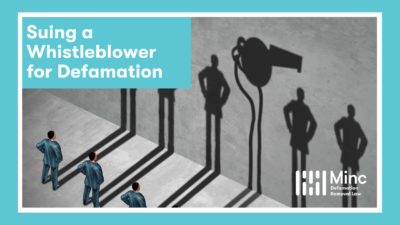
- Originally Published on May 29, 2026
Suing a Whistleblower for Defamation and Malicious Claims

Yes, you can sue a whistleblower for defamation when their claims are knowingly false and made with malicious intent rather than in good faith. Federal and state whistleblower protections shield legitimate reports of misconduct, but they do not immunize individuals who weaponize tip lines, anonymous forums, or SEC complaints to pursue personal vendettas, sabotage competitors, or derail business acquisitions.
As defamation attorneys, we have represented companies and executives targeted by individuals exploiting protections as cover for false accusations. The challenge lies in distinguishing protected disclosure from a malicious smear campaign, then building a litigation-ready case that quantifies real financial harm.
This article explains when whistleblower claims cross into actionable defamation, how to unmask anonymous accusers, and what damages businesses can recover when false reports cause measurable injury.
When Whistleblower Claims Cross Into Defamation
Federal statutes including the Dodd-Frank Act, Sarbanes-Oxley, and the False Claims Act offer broad protection to employees who report suspected violations in good faith. State whistleblower laws extend similar protections at the local level. None of these laws were written to shield knowingly false statements made to harm a business.
A protected disclosure generally requires three things:
- A reasonable, good-faith belief that a violation occurred
- Reporting through proper legal or regulatory channels
- An intent to address actual misconduct, not to inflict harm
When an accuser knowingly fabricates allegations, ignores proper reporting channels, and times disclosures to maximize financial damage to the company, the conduct begins to look less like whistleblowing and more like defamation, tortious interference, or both.
Common Patterns of Malicious Whistleblower Conduct
Not every disgruntled employee is a malicious actor, and not every false claim rises to defamation. But certain patterns appear repeatedly in cases where whistleblower status is being abused. Recognizing these patterns early helps companies build a stronger legal record.
| Warning Sign | Why It Matters |
|---|---|
| Claims filed immediately after termination or denied promotion | Suggests retaliation motive rather than good-faith concern |
| Confidential firm data leaked alongside accusations | Indicates breach of duty and potential trade secret violations |
| Reports timed to coincide with IPO, acquisition, or funding round | Points to financial sabotage rather than public interest |
| Identical claims spread to journalists, competitors, and clients | Shows intent to maximize reputational harm beyond regulators |
| Refusal to participate in internal investigation | Undermines good-faith requirement for whistleblower protection |
| Anonymous posts on Glassdoor, Reddit, or industry forums | Suggests awareness that statements would not survive scrutiny |
When several of these factors appear together, the conduct typically falls outside the scope of legitimate whistleblower protection.
The Financial Stakes of False Whistleblower Claims
The damage caused by malicious whistleblower activity is rarely abstract. False claims can trigger SEC investigations that freeze pending acquisitions, drop public company share prices overnight, or scare off lenders during a critical funding round. For private companies, the impact often shows up as canceled contracts, lost clients, and reduced valuation multipliers during a sale.
These damages are quantifiable, which matters when building a defamation case. Calculable harm strengthens both settlement leverage and trial outcomes.
Using a John Doe Subpoena to Unmask Anonymous Accusers
Most malicious whistleblowers operate behind anonymous accounts. You cannot sue someone you cannot identify, which is why unmasking the accuser is usually the first step.
A John Doe subpoena allows our firm to compel platforms, internet service providers, and email hosts to disclose identifying information about anonymous posters. Once the person is named, the matter shifts from a vague online problem into a litigation-ready case with calculable damages and a clear defendant.
In many cases, the unmasking process itself reveals the true motive behind the attack.
Elements of a Defamation Claim Against a False Whistleblower
To succeed in a defamation suit against someone abusing whistleblower status, the plaintiff generally must prove the following:
- Falsity. The statements must be demonstrably untrue, not opinions or interpretations.
- Publication. The statements were communicated to third parties, whether regulators, journalists, or the public.
- Fault. The accuser knew the statements were false or acted with reckless disregard for the truth.
- Damages. The statements caused measurable harm to the business or executive.
Public companies and high-profile executives may also face the “actual malice” standard, which requires proof that the accuser knew the statements were false or acted with reckless disregard. Internal records, communication patterns, and the timing of accusations often supply the evidence needed to meet this higher bar.
Removing Defamatory Content From the Internet
Litigation is only half the strategy. Most companies care just as much about getting the harmful content offline as they do about winning damages. A court order obtained through defamation litigation can be used to compel platforms to remove false posts and to push search engines to delist defamatory URLs from search results.
Coordinated legal and content removal strategies typically produce the strongest results. Suing in isolation rarely scrubs the internet, and content removal alone does not deter future attacks.
What About Anti-SLAPP Statutes?
Many states have Anti-SLAPP laws designed to protect speakers from lawsuits aimed at silencing protected speech. These laws can apply to whistleblower-related defamation claims, which is why case framing matters so much.
A complaint built around demonstrably false factual statements, supported by evidence of malicious intent and quantifiable damages, is far more likely to survive an Anti-SLAPP motion than one that challenges matters of opinion or commentary. Experienced defamation counsel structures the case to focus on falsity and harm from the start.
Frequently Asked Questions
Can you sue a whistleblower if the SEC declines to investigate?
Yes. The SEC’s decision not to pursue a tip does not bar a private defamation action. In fact, a declined investigation can support the argument that the underlying claims lacked merit, especially when paired with evidence the accuser knew the allegations were false.
Are SEC whistleblower complaints absolutely privileged?
Statements made directly to regulators may carry some level of privilege, but that privilege rarely extends to parallel statements made on social media, anonymous forums, or to journalists. Most defamation cases focus on the public-facing statements that fall outside any regulatory privilege.
What damages can a company recover from a false whistleblower?
Recoverable damages may include lost profits, drops in share price tied to specific statements, canceled or terminated contracts, decreased valuation in a sale, and reputational harm. In cases involving malicious intent, punitive damages may also be available.
How long does a whistleblower defamation case take?
Timelines vary, but most cases move through unmasking, discovery, and either settlement or trial within 12 to 24 months.
Targeted by a Malicious Smear Campaign? Minc Law Can Help
If your company or career is being damaged by someone abusing whistleblower protections to spread false claims, time matters. Evidence disappears, deals close, and search results harden. The defamation attorneys at Minc Law have helped hundreds of businesses and executives unmask anonymous attackers, remove harmful content, and recover damages for false statements.
Contact us today for a free case review.
Call (216) 373-7706 or fill out our contact form below to speak with an experienced defamation attorney.
Get Your Free Case Review
Fill out the form below, and our team will review your information to discuss the best options for your situation.
This page has been peer-reviewed, fact-checked, and edited by qualified attorneys to ensure substantive accuracy and coverage.