(216) 373-7706
- Originally Published on September 3, 2025
Should I Use ChatGPT to Write My Legal Documents?

Artificial intelligence tools like ChatGPT have exploded in popularity. They are fast, accessible, and appear capable of handling everything from writing emails to drafting resumes. Some people even attempt to use ChatGPT to write serious legal documents such as cease and desist letters, contracts, or even court filings.
At first glance, it may seem like a convenient shortcut. Why pay an attorney when an AI tool can generate a professional-looking document in seconds? Unfortunately, the reality is that relying on ChatGPT for legal drafting is not just ineffective but risky. At Minc Law, we have seen firsthand how do-it-yourself attempts with AI often leave clients in worse situations than before.
This article explains why ChatGPT should not be used to draft legal documents, what risks you face when relying on AI, and what you should do instead to protect yourself and your reputation.
Why ChatGPT Is Not a Substitute for a Lawyer
Confidential Information May Not Be Private
Depending on how you access ChatGPT, your information may or may not be stored. Free consumer versions and third-party apps may keep a record of your inputs, while some versions offer more control over data use. The key point is this: unless you are certain of the platform’s privacy policies, you should assume anything you type could be stored or reviewed.
Legal matters often involve highly sensitive details about your personal life, business, or finances. Those details are protected when shared with an attorney because of attorney-client privilege. ChatGPT and other AI tools do not offer that same safeguard.
During a candid July 2025 episode of This Past Weekend with Theo Von, OpenAI CEO Sam Altman delivered a striking warning that underscores why legal confidentiality simply doesn’t apply to AI tools like ChatGPT:
“People talk about the most personal s*** in their lives to ChatGPT. People use it — young people, especially, use it — as a therapist, a life coach; having these relationship problems and [asking] ‘what should I do?’ And right now, if you talk to a therapist or a lawyer or a doctor about those problems, there’s legal privilege for it. There’s doctor‑patient confidentiality, there’s legal confidentiality, whatever. And we haven’t figured that out yet for when you talk to ChatGPT.” Altman continued bluntly: “So if you go talk to ChatGPT about your most sensitive stuff and then there’s like a lawsuit or whatever, we could be required to produce that, and I think that’s very screwed up.
Altman’s message is clear and sobering: unlike confidential conversations with a lawyer, there is no legal shield around what you share with an AI chatbot. If your ChatGPT exchange becomes relevant in litigation, it could be subpoenaed. This isn’t theoretical; it’s a present, actionable risk.
AI Cannot Ensure the Right Legal Effect
One of the biggest risks with ChatGPT is not that it sounds wrong, but that it can sound perfectly polished while using legally ambiguous or strategically flawed language. A cease and desist letter may look professional but escalate a conflict instead of resolving it. A contract may “read well” but contain vague or unenforceable terms.
Even if ChatGPT mimics your writing style or tone, it cannot guarantee that the language has the right legal impact in your situation.
Fabricated Laws and Case Citations
A well-documented flaw of AI is “hallucination.” ChatGPT may produce case law, statutes, or citations that simply do not exist. While this does not happen in every use, it is a known risk when asking the tool to provide legal authority.
Courts have already sanctioned attorneys for submitting briefs containing fabricated case law generated by ChatGPT. If a non-lawyer unknowingly relies on false citations, they risk losing credibility, damaging their case, and in some situations, facing penalties.
No Legal Judgment or Strategy
AI cannot think strategically about your goals, your adversary’s potential response, or the broader context of your dispute. Lawyers evaluate more than the words on the page. They know when to disclose information, when to hold back, and how to frame your position for maximum effectiveness.
ChatGPT generates text without weighing consequences. It cannot substitute for human judgment or experience.
No Accountability or Recourse
If an attorney makes an error, they are bound by professional duties, can be reported to a regulatory body, and are required to carry malpractice insurance. These safeguards exist to protect clients.
ChatGPT offers none of these protections. If an AI-generated document harms your case, there is no insurance, no oversight, and no way to hold the system accountable.
Real-World Risks of Using ChatGPT for Legal Documents
People are most often tempted to use ChatGPT for three categories of legal documents: cease and desist letters, contracts, and court filings. Each carries unique dangers.
Cease and Desist Letters
At Minc Law, we frequently encounter AI-generated cease and desist letters that:
- Reveal unnecessary or damaging details, weakening a client’s negotiating position.
- Use aggressive or threatening language that provokes escalation rather than resolution.
- Misapply or fail to cite the applicable law.
Because these letters are often the first step in resolving a dispute, getting them wrong can destroy opportunities to end the matter quickly and privately.
Contracts and Agreements
Contracts are legally binding documents. ChatGPT may draft something that “looks” like a contract, but appearances can be deceiving. Problems may include:
- Missing key jurisdictional or choice-of-law clauses.
- Unenforceable or contradictory terms.
- Language so vague it offers no real protection.
A defective contract can leave you without remedies if the other party breaches, or worse, expose you to liability yourself.
Court Filings and Legal Briefs
Courts require documents to follow strict formatting, citation, and procedural rules. AI cannot reliably meet these requirements. Filing a defective document can result in delays, sanctions, or dismissal of your case.
In one high-profile example, an attorney submitted a brief in federal court filled with citations to fake case law created by ChatGPT. The court fined him thousands of dollars and publicly criticized the submission.
The Ethical and Professional Standards ChatGPT Cannot Meet
Legal professionals are bound by standards that protect clients and ensure the integrity of the legal system. AI tools like ChatGPT cannot meet these standards.
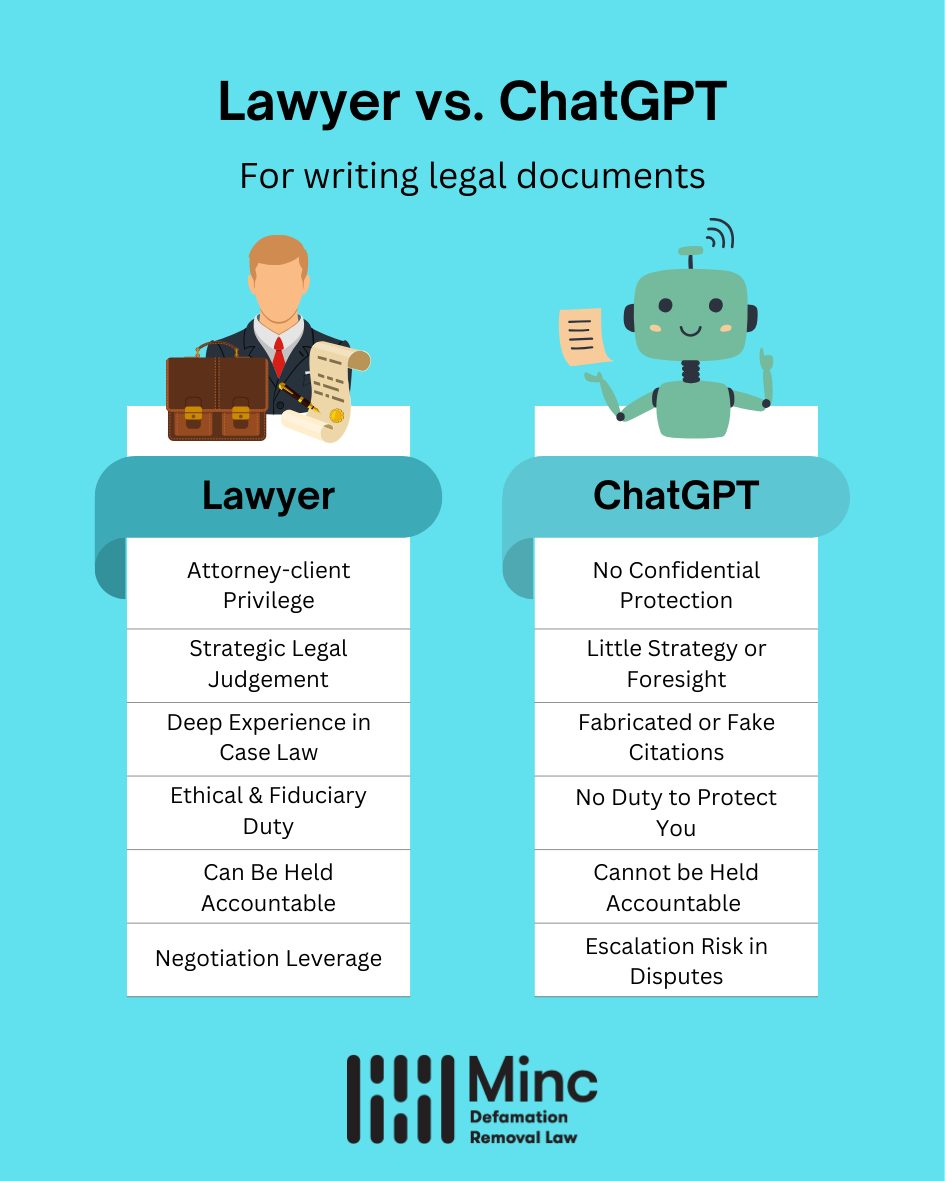
- Attorney-client privilege ensures confidentiality. ChatGPT offers no such protection.
- Fiduciary duty requires attorneys to act in your best interest. AI owes you no duties.
- Malpractice insurance provides recourse if a lawyer errors. AI has no insurance, no oversight, and no accountability.
When you hire an attorney, you are not just paying for words on paper. You are securing professional obligations, ethical duties, and safeguards that AI cannot replicate.
The Future of AI in Law
Artificial intelligence is advancing quickly, and there may come a time when AI tools can safely assist individuals in handling legal tasks. But today, the reality is different.
At its current stage, AI carries enormous risks for anyone trying to rely on it directly. The law has not caught up with the technology, and there are no regulations or consumer protections in place if something goes wrong. If ChatGPT generates false information, exposes your confidential details, or leads you into a costly legal mistake, there is no clear recourse.
That may change in the future. Regulators, courts, and technology companies may eventually create systems that make AI safer and more reliable for consumers. But right now, using AI as a substitute for a lawyer is not just ineffective, it is a liability. Until stronger protections are in place, the safer path is to work with an attorney who can provide confidentiality, judgment, and accountability.
What to Do If You Need a Legal Document
If you are considering using ChatGPT for a legal matter, stop and consider these steps instead:
- Do not upload sensitive details about your case to public platforms.
- Consult an attorney before sending any document to an opposing party.
- Use AI only as a brainstorming aid for your own understanding, not as a finished product.
Most importantly, remember that legal documents are not simply writing exercises. They are strategic instruments that can affect your rights, your finances, and your future.
Bottom Line
It makes sense to wonder if ChatGPT can save you time and money on a legal matter. Many people are asking the same question, and at first glance, the tool looks capable. But for now, AI is a risky shortcut. It can expose private information, generate false citations, and produce documents that do more harm than good.
Because the legal system has not yet developed safeguards for AI mistakes, individuals who rely on ChatGPT are left with no protection if something goes wrong. Until regulations and technology improve, working with a lawyer remains the best way to protect your rights, your reputation, and your future.
At Minc Law, we understand the temptation to turn to AI, but we also see the consequences every day when those shortcuts fail. We are here to help you navigate your legal matter safely, strategically, and with the full protections the law provides.
Get Your Free Case Review
Fill out the form below, and our team will review your information to discuss the best options for your situation.
This page has been peer-reviewed, fact-checked, and edited by qualified attorneys to ensure substantive accuracy and coverage.