(216) 373-7706
- Originally Published on December 19, 2025
Can Businesses Sue Over Fake Ranking or Comparison Websites?

A growing number of businesses are discovering that online “Top 10,” “Best Of,” and comparison websites are not always what they appear to be. In competitive industries, some companies create or influence ranking and comparison sites in ways that mislead customers about who is behind the content and how rankings are determined.
If your business has been affected, you may feel frustrated or uncertain about what to do next. A ranking or comparison site that appears neutral can divert customers, shape purchasing decisions, and unfairly benefit a competitor. You may be wondering whether this conduct crosses a legal line, whether the content can be challenged, and whether there is meaningful recourse against the competitor involved.
At Minc Law, we focus exclusively on online defamation and digital reputation disputes. Our attorneys regularly represent businesses harmed by competitor-driven online deception, including misleading ranking and comparison websites. Depending on the facts, this conduct may implicate defamation, false advertising, unfair competition, or a combination. This article explains when competitor-influenced ranking or comparison sites may be legally actionable and how an attorney can help protect your business.
Are All Comparison and Ranking Sites Illegal?
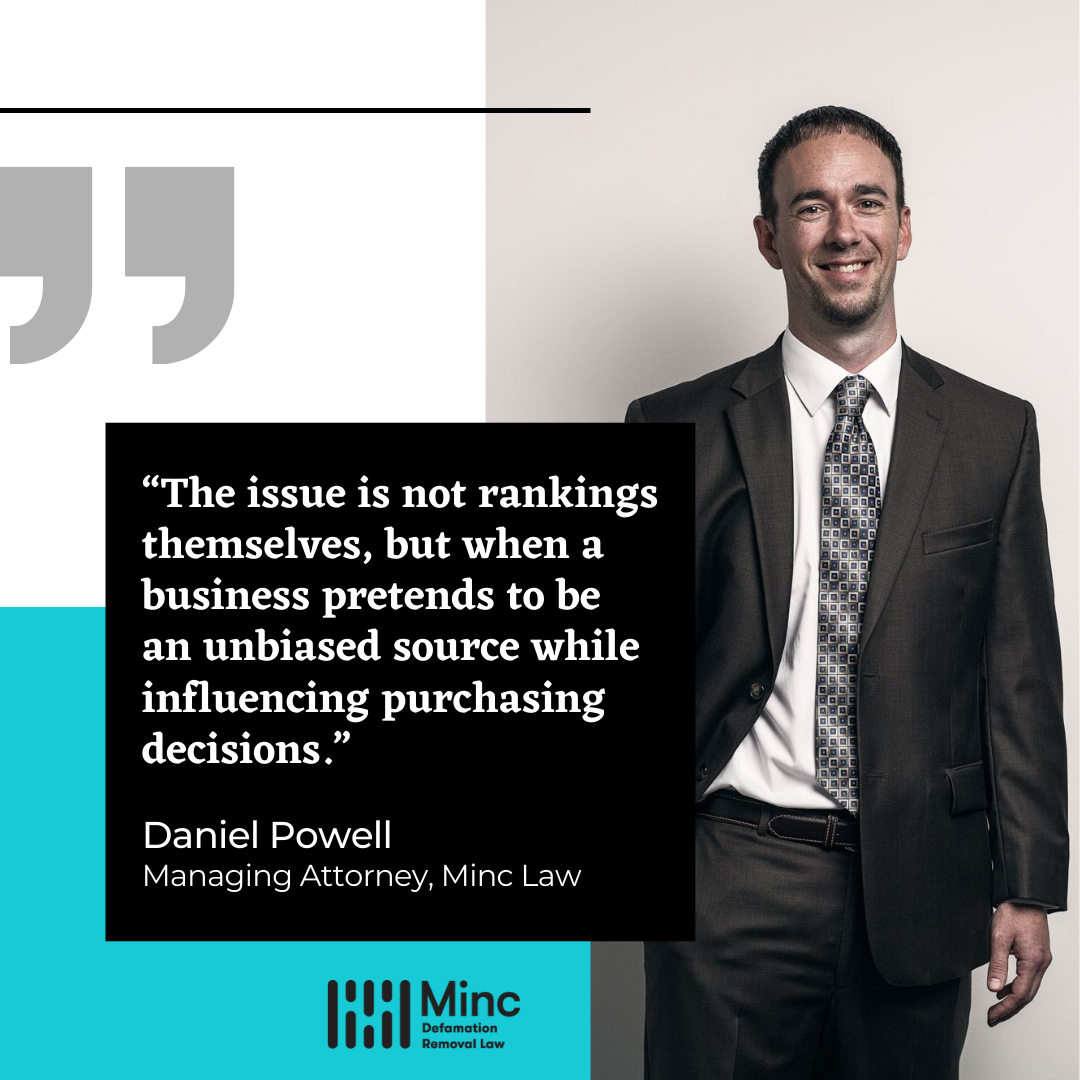
It is important to start with a clear distinction. Not every unfavorable ranking or comparison is unlawful. Businesses, publishers, and reviewers are generally allowed to express opinions, create rankings, and compare services. Legal issues arise not from rankings themselves, but from misrepresentation, particularly when a site claims independence, neutrality, or objectivity while being controlled or influenced by a competitor.
When Does a Ranking or Comparison Site Become Illegal?
Problems arise when a ranking or comparison site is created, funded, or materially influenced by a competitor and presented as an independent resource. In these situations, customers may be misled about who is responsible for the content and why certain businesses are ranked favorably. When competitors disguise advertising or self-promotion as neutral evaluation, the issue can extend beyond aggressive marketing and into false advertising or unfair competition.
The Role of False Independence and Disclosure
A key factor courts examine is whether a site accurately discloses its relationships and incentives. Ranking or comparison sites may cross legal lines when they claim to be independent while being owned or controlled by a competitor, fail to disclose pay-to-play arrangements, present sponsored placements as objective rankings, or rely on fabricated or undisclosed criteria to favor one business. The legal risk is tied to how the site represents itself, not simply to the existence of rankings.
Common Types of Problematic Ranking or Comparison Sites
Competitor-driven ranking schemes can take several forms. These may include “Best Of” websites that consistently rank one company first without explaining their methodology, comparison charts that selectively present information, or review-style sites that appear editorial but function primarily as marketing tools. Pay-to-play models are not inherently illegal, but they may become problematic when sponsorships or financial incentives are not clearly disclosed and the content is presented as unbiased.
Defamation, False Advertising, and Unfair Competition
The legal theory that applies depends on what the site says and how it operates.
When Defamation May Apply
Defamation concerns arise only when a ranking or comparison site makes false statements of fact about a business, such as allegations of fraud, unethical behavior, or professional misconduct. Opinions, rankings, and subjective comparisons generally do not qualify. Simply being ranked lower than a competitor is not defamatory.
When False Advertising or Unfair Competition May Apply
False advertising and unfair competition claims may arise when a competitor misrepresents the independence of a ranking site, disguises advertising as objective evaluation, or uses deceptive comparisons to influence purchasing decisions. In some cases, more than one legal theory may apply, but liability depends on specific and provable misrepresentations.
How These Cases Are Typically Evaluated
When businesses suspect a ranking or comparison site is deceptive, the analysis usually focuses on who controls or funds the site, how rankings are determined, whether material relationships are disclosed, whether factual claims are false or misleading, and whether the conduct causes competitive harm. Each situation is highly fact-specific.
When to Speak With an Attorney
Legal guidance may be appropriate when a ranking or comparison site appears to be controlled by a competitor, misrepresents its independence, includes false factual statements about your business, or is causing measurable harm. In these situations, an attorney can help investigate who is behind the site, assess whether the conduct crosses legal lines, and determine whether defamation, false advertising, unfair competition claims, or a combination of these may apply.
Minc Law Can Help
Minc Law focuses exclusively on internet defamation and online reputation disputes. Our attorneys help businesses evaluate competitor-driven deception and pursue appropriate remedies when warranted. If you believe a competitor is using a deceptive ranking or comparison website to harm your business, contact Minc Law for a confidential case evaluation to discuss your options and determine the most effective path forward.
Get Your Free Case Review
Fill out the form below, and our team will review your information to discuss the best options for your situation.
This page has been peer-reviewed, fact-checked, and edited by qualified attorneys to ensure substantive accuracy and coverage.