(216) 373-7706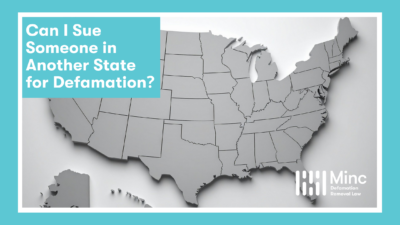
- Originally Published on April 20, 2026
Can I Sue Someone in Another State for Defamation?

Yes. Suing a defendant in another state for defamation is legally possible when a court establishes personal jurisdiction through 2 pathways: general jurisdiction and specific jurisdiction. Each pathway is governed by the state’s long-arm statute and constitutional due process requirements.
What Defamation Is
Defamation is the publication of a false statement of fact that damages the reputation of an identifiable person. Courts recognize 2 forms of defamation:
- Libel: written or broadcast false statements
- Slander: spoken false statements
To establish a valid defamation claim, a plaintiff must prove 5 elements:
- A false statement of fact
- Publication to at least one third party
- Identification of the plaintiff in the statement
- Fault, at minimum negligence, and actual malice for public figures
- Damage to the plaintiff’s reputation
Defamation per se is a category of statements for which courts presume damages without requiring the plaintiff to prove specific harm. These statements include false accusations of criminal conduct, sexual misconduct, professional incompetence, or a contagious disease. Defamation per quod requires the plaintiff to present proof of special damages caused by the false statement.
Personal Jurisdiction in Cross-State Defamation Cases
Personal jurisdiction is a court’s legal authority to compel a named defendant to litigate in that court. A court lacking personal jurisdiction over the defendant dismisses the case regardless of the defamation claim’s merit.
2 types of personal jurisdiction apply to defamation lawsuits filed against out-of-state defendants:
General jurisdiction exists when the defendant maintains continuous, systematic, and substantial contacts with the forum state, such as residing there, incorporating there, or maintaining a principal place of business there. A court with general jurisdiction over a defendant handles any claim, regardless of where the defamatory act occurred.
Specific jurisdiction exists when the defendant’s particular conduct connects directly to the forum state. The defamatory act itself must create that connection. Specific jurisdiction does not require the defendant to maintain a residence or general presence in the forum state.
How Long-Arm Statutes Enable Out-of-State Defamation Lawsuits
Long-arm statutes are state laws that permit courts to exercise personal jurisdiction over out-of-state defendants whose specific conduct connects them to the state. Every state maintains a long-arm statute. These statutes enumerate the acts through which a nonresident defendant becomes subject to local jurisdiction, including:
- Committing a tortious act that causes injury within the state
- Transacting business within the state
- Owning, using, or possessing real property within the state
- Sending electronic, telephonic, or written communications into the state from which the cause of action arises
For a court to exercise long-arm jurisdiction over an out-of-state defamation defendant, 2 conditions must be satisfied:
- The defendant’s conduct falls within one of the acts the state’s long-arm statute enumerates
- Exercising jurisdiction does not violate the Due Process Clause of the U.S. Constitution
State-by-state variation in long-arm statutes directly affects defamation plaintiffs. New York’s long-arm statute expressly excludes defamation from its tortious act provision, making it narrower than statutes in Florida and Ohio. Florida and Ohio extend jurisdiction to any electronic communication directed at their residents.
The Minimum Contacts Requirement
Minimum contacts is the constitutional standard established in International Shoe Co. v. Washington, 326 U.S. 310 (1945), requiring a defendant to have sufficient connections to the forum state before that state exercises personal jurisdiction. A defendant satisfies minimum contacts through either:
- Systematic and continuous activity within the forum state, which supports general jurisdiction
- A specific act within or directed at the forum state from which the lawsuit arises, which supports specific jurisdiction
In Asahi Metal Industry Co. v. Superior Court, 480 U.S. 102 (1987), the U.S. Supreme Court clarified that even verified minimum contacts do not automatically justify jurisdiction. Courts also weigh 4 additional fairness factors:
- The burden on the defendant in litigating in the forum state
- The forum state’s interest in adjudicating the dispute
- The plaintiff’s interest in a convenient forum
- Overall judicial efficiency
The Effects Test: The Jurisdictional Standard for Defamation
The effects test, derived from Calder v. Jones, 465 U.S. 783 (1984), is the primary framework courts apply to determine personal jurisdiction over out-of-state defendants in defamation cases. Under the effects test, specific personal jurisdiction is established when 3 conditions are satisfied:
- The defendant committed an intentional act, such as writing or publishing the defamatory statement
- The act was expressly aimed at the forum state
- The defendant knew the harm would be felt primarily in the forum state
In Calder v. Jones, actress Shirley Jones, a California resident, sued 2 Florida-based National Enquirer employees: the article’s author and its editor-in-chief. The Enquirer circulated approximately 600,000 copies in California, nearly double the circulation of any other state. The U.S. Supreme Court unanimously upheld California’s jurisdiction because California was the focal point of both the article and the reputational harm Jones suffered.
In Walden v. Fiore, 134 S. Ct. 1115 (2014), the Supreme Court clarified that the defendant’s own conduct, not the plaintiff’s residence, must create the contact with the forum state. A defendant does not become subject to a state’s jurisdiction solely because the plaintiff lives there and experienced harm there.
Where to File a Defamation Lawsuit Against an Out-of-State Defendant
Defamation plaintiffs filing against out-of-state defendants evaluate 4 venue options:
- The plaintiff’s home state: Proper when the defamatory statements targeted the plaintiff in that state and the brunt of the reputational harm concentrated there. When the defendant’s identity or location is unknown, the plaintiff’s home state is the preferred filing jurisdiction.
- The defendant’s home state: Always proper, as courts in a defendant’s state of residence exercise general jurisdiction over that defendant for any claim.
- The state where the defamatory content originated: Applicable when the defendant published the statement from a specific state and that publication constitutes the actionable conduct.
- The state where the plaintiff suffered measurable financial loss: Courts recognize injury-based specific jurisdiction when documented economic harm occurred within the state and the defendant’s statements targeted that state.
Federal Court as an Option: Diversity Jurisdiction
Federal courts hear defamation cases between parties from different states through diversity jurisdiction. Diversity jurisdiction, codified in 28 U.S.C. § 1332, requires 2 conditions:
- Complete diversity, meaning every plaintiff is a citizen of a different state from every defendant
- The amount in controversy exceeds $75,000
In a federal diversity defamation case, the court applies the substantive defamation law of the state where it sits, following the Erie doctrine from Erie Railroad Co. v. Tompkins, 304 U.S. 64 (1938). A federal district court sitting in diversity also applies the personal jurisdiction rules of the state in which it sits when evaluating authority over an out-of-state defendant. Federal defamation proceedings apply the same effects test analysis that state courts use to assess minimum contacts with nonresident defendants.
Internet Defamation and Interstate Jurisdiction
Online defamation, including false statements published on social media platforms, consumer review sites, and websites, presents distinct jurisdictional questions because content is simultaneously accessible in all 50 states. Courts across the country disagree on whether mere online accessibility creates sufficient contact with a state.
States including Illinois, Indiana, Kansas, New Mexico, Florida, and Ohio hold that nonresidents who defame online residents of those states expressly direct their statements to audiences there, satisfying the minimum contacts standard. States including Arizona, Minnesota, Missouri, New Jersey, New York, and West Virginia require specific evidence that the poster directed comments toward that state’s audience. Accessibility alone fails to confer jurisdiction in those states.
The controlling question in internet defamation jurisdiction is whether the defendant specifically targeted the forum state, not whether residents there happened to access the defamatory content.
Pre-Filing Requirements for Interstate Defamation Lawsuits
Several states impose pre-suit obligations on defamation plaintiffs before a lawsuit proceeds. Plaintiffs filing across state lines must identify and comply with the retraction or correction statutes of the applicable jurisdiction:
- Florida: The plaintiff serves a written demand on the defendant at least 5 days before filing, specifying the article or broadcast and the statements alleged to be false and defamatory.
- Texas: The plaintiff makes a timely request for correction, clarification, or retraction from the defendant. Failure to submit this request within 90 days of discovering the publication bars recovery of exemplary damages.
- Washington: The plaintiff submits a written, adequate request for correction or clarification. The request specifies the false statement, alleges its defamatory meaning, and states that the meaning is false.
Statutes of limitations for defamation claims range from 1 to 3 years across states. The applicable statute of limitations is one of the primary factors in selecting a filing venue. A claim time-barred in one state may remain actionable in another state where the limitations period has not expired.
How Minc Law Handles Interstate Defamation Cases
Minc Law is a Cleveland, Ohio-based internet defamation law firm that has litigated over 350 defamation cases across 26 states and 5 countries and removed over 50,000 pieces of defamatory online content. Aaron Minc, the firm’s founder, is a nationally recognized internet defamation attorney with over a decade of litigation experience in both state and federal courts.
Minc Law’s attorneys conduct a complete jurisdictional analysis before filing any interstate defamation lawsuit, evaluating:
- The defendant’s known and discoverable contacts with each potential forum state
- The location where the defamatory content was published and the states where it was accessed
- The states where the plaintiff suffered documented reputational and financial harm
- The advantages and disadvantages of state court versus federal court in each viable jurisdiction
- Applicable pre-suit retraction requirements and statutes of limitations in each forum
Minc Law offers a free initial consultation for individuals and businesses addressing defamation by out-of-state defendants. If you are facing defamation from someone in another state, contact Minc Law today by calling (216) 373-7706 or filling out our contact form below.
Get Your Free Case Review
Fill out the form below, and our team will review your information to discuss the best options for your situation.
This page has been peer-reviewed, fact-checked, and edited by qualified attorneys to ensure substantive accuracy and coverage.