(216) 373-7706
- Originally Published on January 13, 2026
Can You Sue If You Are Falsely Accused of Racism?

Being falsely accused of racism can be devastating. These allegations can destroy careers, damage personal relationships, and permanently harm your reputation. Many people ask the same urgent question: can you sue if you are falsely accused of racism? In many cases, the answer is yes. If the accusation involves false statements of fact, is communicated to others, and causes reputational harm, you may have a viable defamation claim or other legal options.
If you are facing false racism allegations, you are not powerless. At Minc Law, we regularly help individuals and businesses respond to defamatory accusations and reclaim their good name. In this article, we explain when false accusations of racism may be legally actionable, what you need to prove to sue for defamation, and the critical steps you should take to protect your reputation.
What Constitutes Defamation in False Racism Accusations?
Defamation occurs when someone makes a false statement of fact about another person that harms their reputation. In cases involving false accusations of racism, courts closely examine whether the allegation goes beyond protected opinion and crosses into provably false factual claims.
To sue for defamation, you generally must prove four elements:
- A false statement of fact: The accusation must be objectively untrue. Truth is an absolute defense to defamation.
- Publication to a third party: The accuser must communicate the statement to someone other than you, such as coworkers, customers, an employer, or an online audience.
- Fault: Depending on the circumstances, you must show the accuser acted at least negligently, or with actual malice if you are a public figure or the situation involves certain constitutional standards.
- Damages: The accusation must cause reputational harm, financial loss, emotional distress, or other recognized injury.
Courts are more likely to find defamation when an accuser alleges specific racist conduct, such as discriminatory actions, racial slurs, or unlawful behavior, rather than using vague or hyperbolic labels. A false claim that someone engaged in particular racist acts may be actionable, while generalized name-calling may be protected opinion depending on the context.
Can You Sue for False Accusations of Racism?
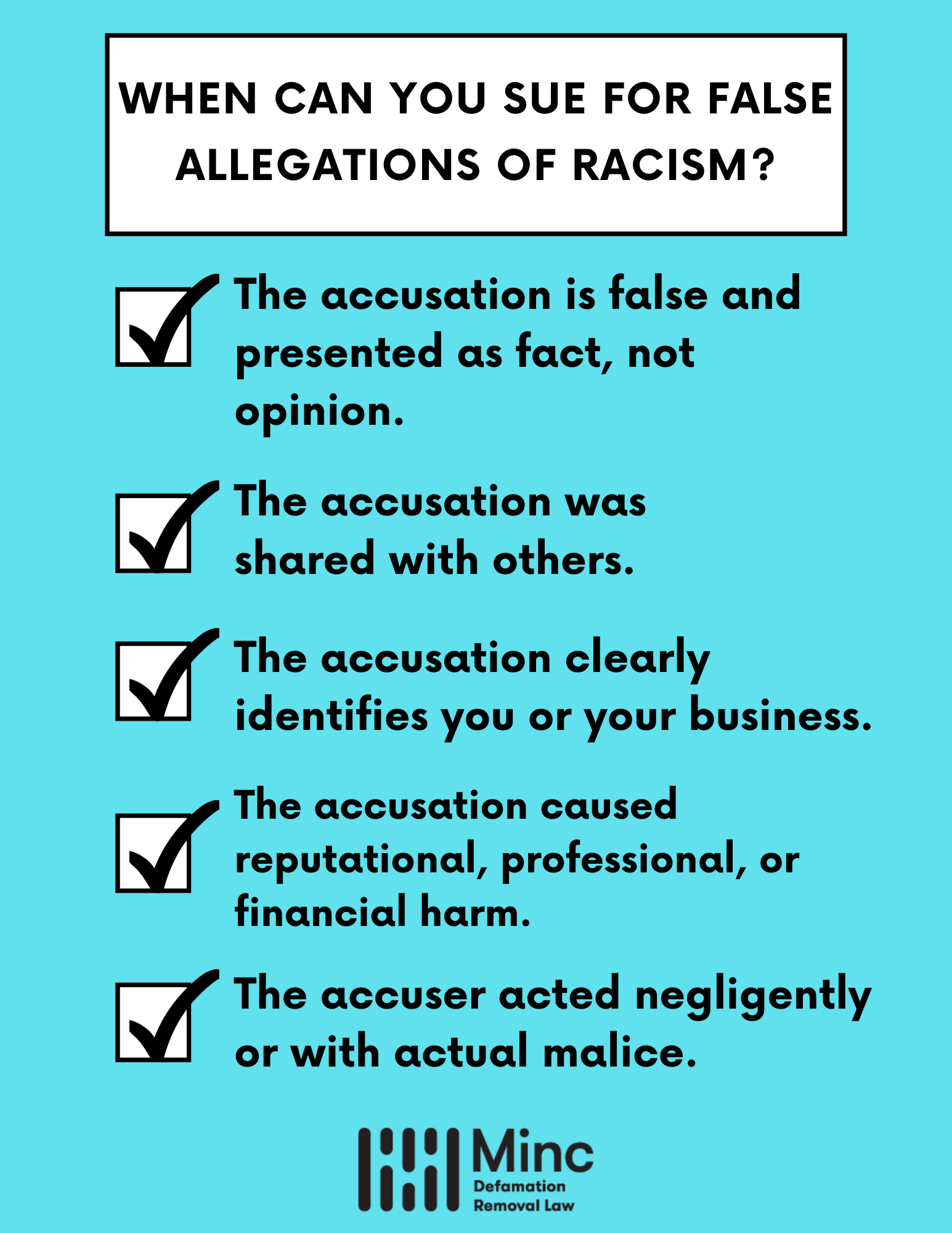
Yes, you can sue for false accusations of racism in many situations, but the viability of a lawsuit depends on what was said, how it was said, and whether the accusation can be proven false. A defamation lawsuit is strongest when the accusation:
- States or clearly implies specific, verifiable facts
- Is shared with others, including online or in the workplace
- Can be disproven with credible evidence
- Causes measurable harm to your reputation, job, business, or relationships
It is also important to understand that the First Amendment protects many opinions, even harsh ones. In practice, the key question is often whether the statement would be understood as a factual claim or as opinion, rhetoric, or interpretation based on disclosed facts.
What Damages Can You Recover for Defamatory Racism Allegations?
If false accusations of racism have defamed you, you may be entitled to recover several types of damages, depending on the facts of your case:
- Special damages: Compensation for measurable financial losses, such as lost income, terminated contracts, or business decline.
- General damages: Compensation for non-economic harm, including emotional distress, humiliation, and reputational injury.
- Punitive damages: Damages intended to punish malicious or reckless conduct and deter similar behavior.
- Nominal damages: A symbolic award recognizing that your rights were violated, even if financial losses are difficult to quantify.
The availability and amount of damages depend on factors such as how widely the accusation was published, the intent of the accuser, and the impact on your personal and professional life.
How Can You Prove a Racism Accusation Is False?
To succeed in a lawsuit for false accusations of racism, you need credible evidence showing the allegation is untrue and that it was presented as a statement of fact. Evidence that may help disprove defamatory allegations includes:
- Witness testimony from individuals with direct knowledge of the events
- Emails, text messages, or online communications contradicting the accusation
- Audio or video recordings that refute the alleged conduct
- Employment records, investigative reports, or official findings disproving the claim
Tips for preserving critical evidence:
- Capture screenshots of online accusations immediately before they are altered or removed
- Securely back up electronic communications and digital files
- Maintain a detailed timeline documenting interactions, witnesses, and fallout
- Preserve records demonstrating your professional conduct and history
Careful documentation is often the foundation of a successful defamation claim.
Should You Respond to False Racism Allegations Publicly?
It is understandable to want to defend yourself publicly after being falsely accused of racism. However, emotional or impulsive responses can escalate the situation and create additional risk. Consider the following guidelines before responding publicly:
Do:
- Limit statements to verifiable facts and avoid speculation
- Maintain a respectful, measured tone
- Consult a defamation attorney before issuing public statements
- Acknowledge the seriousness of racism while clearly denying false allegations
Don’t:
- Engage in personal attacks or online arguments with the accuser
- Discuss confidential investigations or legal strategy publicly
- Make defensive statements that could be misinterpreted or taken out of context
- Post anything you would not want reviewed by opposing counsel or a judge
In many cases, silence paired with decisive legal action is the most effective response.
When Should You Consult an Attorney About False Racism Accusations?
False accusations of racism can escalate quickly and cause irreversible damage if not addressed promptly. Consulting an experienced defamation attorney early can help protect your rights and evaluate whether you can sue for false accusations of racism. You should strongly consider legal counsel if:
- The accusation has been published online, in the media, or on social platforms
- Your employer has initiated an investigation or disciplinary process
- You are experiencing harassment or threats related to the accusation
- The allegations are interfering with your career or business
- You are considering a defamation claim or other legal action
An attorney can help you evaluate your options, preserve evidence, and take immediate steps to mitigate reputational harm.
What Are Your Legal Options for Fighting False Racism Allegations?
If you are considering suing for false accusations of racism, it helps to understand the legal tools that may be available. Depending on the facts, options can include cease and desist letters, retraction demands, and defamation lawsuits.
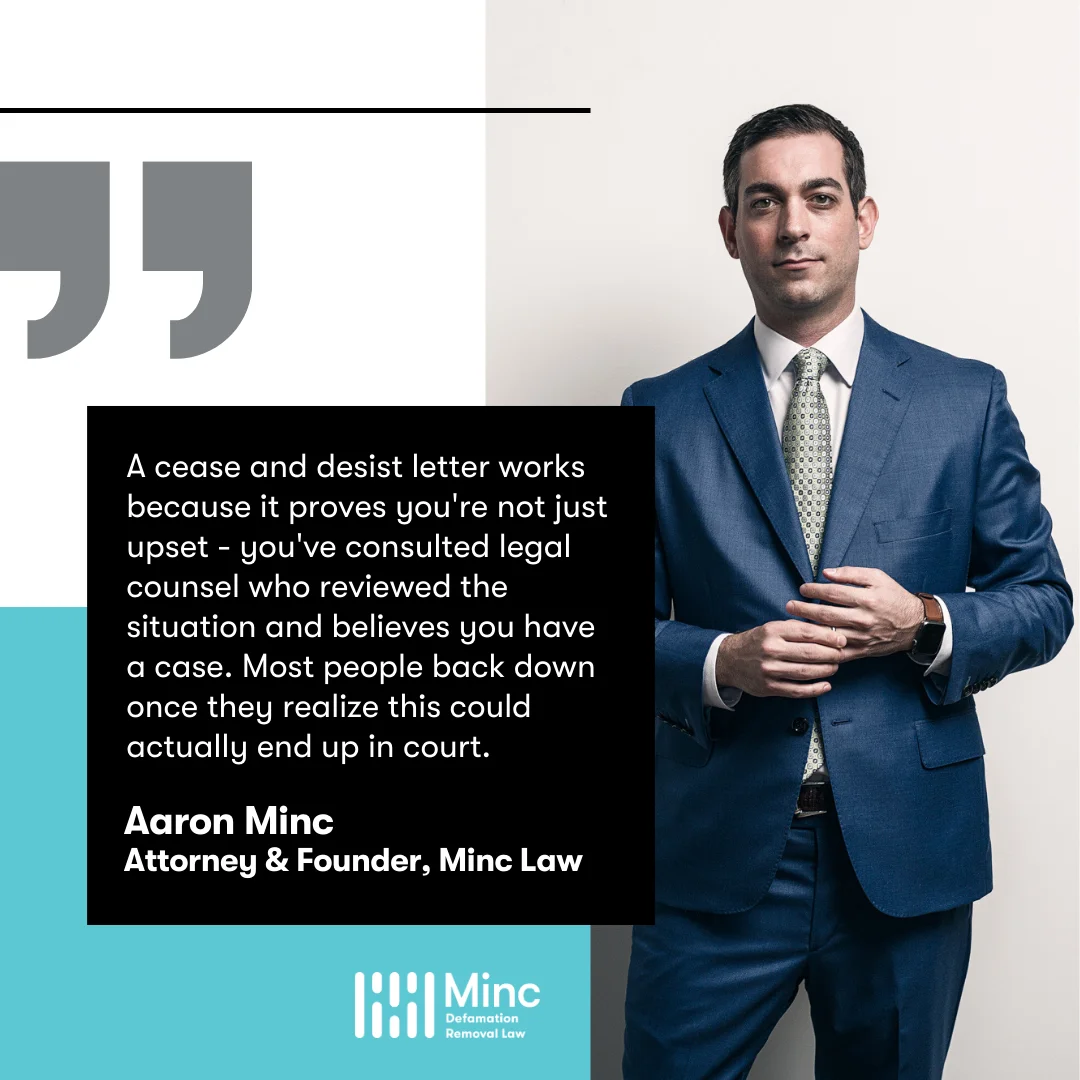
A cease and desist letter is a formal notice demanding that the accuser stop making false statements and retract defamatory claims. In some cases, this step is enough to halt further publication and create a clear record that the accuser was put on notice.
If the accusations persist or have already caused significant harm, a defamation lawsuit may be appropriate. A lawsuit can seek monetary damages and, in some situations, court orders related to removal or future publication.
Factors to consider when deciding whether to pursue legal action include:
- The scope and reach of the false allegations
- Whether the statements are provably false facts rather than opinion
- Whether you can show the required level of fault
- The strength and availability of supporting evidence
- The severity of reputational, emotional, and financial harm
- The practicality of recovering damages
An experienced defamation attorney can help determine the most effective strategy based on your goals and risk tolerance.
Moving Forward After a False Racism Accusation
Being falsely accused of racism can feel isolating and overwhelming, but you do have options. By preserving evidence, avoiding reactive public responses, and working with a skilled defamation attorney, it is possible to confront false allegations and restore your reputation.
At Minc Law, we help clients address serious reputation threats, including false accusations of racism and other forms of defamation. We understand what is at stake and work strategically to protect what matters most.
If you are ready to explore whether you can sue for false accusations of racism, we invite you to speak with our team. Together, we can assess your situation and develop a plan to move forward with clarity and confidence.
For an initial no-obligation case review, contact a chat representative, complete our contact form, or call us at (216) 373-7706.
Get Your Free Case Review
Fill out the form below, and our team will review your information to discuss the best options for your situation.
This page has been peer-reviewed, fact-checked, and edited by qualified attorneys to ensure substantive accuracy and coverage.